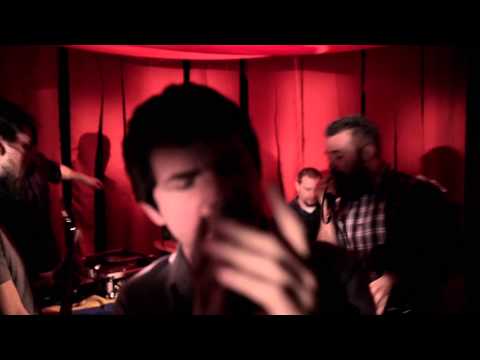
I was just thinking about Coma a few days ago. I don't know why. I thought I miss one of their beautiful songs. And here I see on YouTube they released a new video just when I was thinking of them. This one is a very nice combination of Catalin's lyrics, melodic and hard sounds and a cool interweave of the voices of Catalin and Dan - it's not the usual contrast between singing and shouting, but rather a vocal collaboration which works surprisingly well. Without further ado, here it is.
Chip, by Coma:
\

Also, if you want to see a live version:

I have at work a very annoying HTTP proxy that requires a basic authentication. This translates in very inconsistent behaviour between applications and the annoying necessity of entering the username and password whenever the system wants it. So I've decided to add another local proxy to the chain that handles the authentication for me forever.

This isn't as easy as it sounds. Sure, proxies are a dime a dozen, but for some reason most of them seem to be coming from the Linux world. That is really bad user interaction, vague documentation and unhelpful forums where any request for help ends up in some version of "read the fucking manual". Hence I've decided to help out by creating this lovely post that explains how you can achieve the purpose described above with very little headache. These are the very easy steps that you have to undertake:
  1. Download and install Privoxy
  2. Go to the Program Files folder and look for Privoxy. You will need to edit two files: config.txt and user.action
  3. Optional: change the listen-address port, otherwise the proxy will function on port 8118
  4. Enter your proxy authentication username and password in the fields below and press Help me configure Privoxy - this is strictly a client base Javascript so don't worry that I am going to steal your proxy credentials...
  5. Edit user.action and add the bit of text that appeared as destined for that file.
  6. Edit config.txt, look for examples of forward and add to it the bit that belongs to config.txt and replace proxy:port and the domains and IP masks with the correct values for you
  7. Restart Privoxy
  8. Configure your internet settings to use a proxy on 127.0.0.1 and the port you configured in step 2 (or the default 8118)

This should be it. Enjoy!

Username:

Password:


I've reached the last of the animes in the Studio Ghibli series that I wanted to watch (again) and it was nice that this one got to be the final one. You see, before that I had watched The Cat Returns and I rated it mediocre, so unlike the beautiful movies from the same collection. Whisper of the Heart seems to be the film designed to redeem it.

The story is that of a young girl who likes to read a lot of books. She notices that most of the books that she borrowed from the library had the same name on their library cards, a boy that she didn't know. Coincidentally she follows a fat cat, apparently named Muta, to the shop of an old man who has a beautiful doll of a cat in a suit: the Baron of Gikkingen. You guessed it, two characters from The Cat Returns. And behold, the old man is the grandfather of the boy that kept borrowing the same books.

Whisper of the Heart seems to just take beautiful elements from other Ghibli animes and bring them all together in a wonderful union. The windy hills of Tokyo, which still has beauty despite the expansion of the city. The young girl who is not only smart and sensible, but also ambitious and kind. The family who is sometimes annoying and overbearing, but that in the end is the source of support for the development of the child it nurtures. The indolent fat cat :)

And then the love story, something that springs from common interests and a karmic connection between two people who seem to have been meant for each other. But there is more. They don't just click and that's it; they get motivated and energized to be the best of what they can be in order to honor the relationship in which they enter. In a way, it is a continuation of the warm and supporting family model from which both protagonists come.

One of the scenes in the anime was so funny to my wife that she spoke the Japanese words from it for a week. What a wonderful thing to have a film that not only makes me want to be a better man, but that already does make me be so by connecting me stronger to the one I love. And I watched it on Valentine's day, too! How can I rate it any less than with a perfect 10?

Returning to The Cat Returns, it somehow felt to me that the story linked to it also from the perspective of the ever aspiring artist; the rough and unpolished plot there sounds a lot like the story Shizuku writes, her first but one in many, the stone that will allow her to get to the skill and experience to do this story, which is so much better and complete. It does seem that way to me, since I watched The Cat Returns first, but chronologically Whisper of the Heart was made seven years earlier.

Now I don't know exactly in which proportion is Hayao Miyazaki responsible for the great quality of this film and story and how much Hiiragi Aoi, the writer of the original manga, but I heartily recommend the end result. I may be exaggerating, but this could be the best anime Studio Ghibli ever did, and that is saying much.

I can't say that Neko no ongaeshi had a great effect on me. The animation was OK, the story was like a fairy tale, but it lacked something, a special feeling that I was expecting to have.

The plot is that a young girl saves a cat from death and finds herself uncomfortably rewarded by the entire hidden nation of cats with a trip to their kingdom, a marriage to their prince and a free transformation into a feline. She doesn't want this, but helped by new friends, she manages to escape. I am not really spoiling anything here. It wasn't like at any moment I felt that she might be in real danger, which I think was the biggest flaw of the story. Another anime from Studio Ghibli, Spirited Away, features a much more beautiful and scary foray in a magical world and one of the novels of Clive Barker, The Thief of Always, brings the required tension and fear that is missing in this film.

Another issue I had with this is that, other than eat mice and fish, the cats behaved exactly like humans, missing entire opportunities to delight the viewer with so many catty things. They don't use their claws, they don't do acrobatics, they live in a feudal community and are loyal to each other. The whole concept of a feline kingdom passed right by the creators of the anime.

My conclusion is that this is a film for very little children or a lazily made one. It's not that I didn't enjoy watching it, but was completely bland, devoid of any inspiration that would make it rise above average.

I always liked animes from Studio Ghibli., but until now I didn't quite get why. It is because they have calm. Everything today has to be over the top, flashy, fast. Ghibli stories take their time, they feature normal people with normal desires and rhythms. behaving normally.

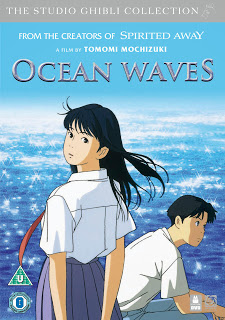
The Ocean Waves is about a cute girl moving from Tokyo to a provincial highschool in Kochi. Everybody is curious about her, but she is a loner and quite rude. Two friends are both interacting with her, but it's never clear what's in their hearts. Slowly, but surely, we start to understand each of the actors and the story comes full circle after graduation, at the first highschool reunion.

I've learned so much about Japanese culture from animes, but the ones from Ghibli make me understand the people. The stories often have what is missing in not only animation, but real actor movies as well: people that you can empathise with, because they are like you (or rather, like you would like to be, but not in infantile fantasies, but in your hopeful dreams).

Really nice movie, it certainly worth seeing.

When I first started watching the movie and I saw the way it was drawn - colored pencil style, I thought it is some sort of children thing and I would not like it. But the minimalistic animation works very well for this film, which shows the everyday life of a Japanese family. They are not very smart, good looking or have anything special. They are forgetful, self centered and lazy. But they have each other and they are happy. That's a beautiful message in a world dominated by heroes, celebrity and egotism.

One might not like one thing, that the story is merely descriptive. There is no "end" to it, just a funny enumeration of family moments. I enjoyed it, though. The speech at the beginning, from the woman advising the newly weds what life is and how they should spend it together is both funny, mostly true and descriptive of the rest of the film. The part with "life is hard when you are alone, but even two losers can go through life if they are together" cracked me up, as well as the part with "have children, it will help you appreciate your parents; they will come and take care of them for you from time to time".

The bottom line is that this is a movie that families should watch together. It would relieve the pressure of never appearing to make mistakes, trying to be a perfect whatever and missing the joy of life. Now, it's too late for my family, but this film may be a way to screw up your children less.

So, while this would not be for everyone, The Yamadas is one of those Studio Ghibli. animes that makes you have warm feelings.

A lot of people nowadays are born in the city or a large town somewhere; nature and animal life is something you see on TV. Few older people, though, may remember what life used to be mere decades ago, when wild nature was what awaited you when you got out of your yard and people were three times fewer.

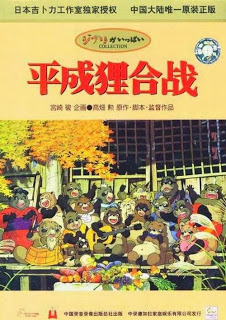
Pom Poko is a movie about the changes urban development brings to the land, as seen from the perspective of a playful and intelligent race of racoons, magically endowed with the ability to shapeshift into anything they choose. Worried, scared and finally enraged by the destruction of their home forests by the expansion of Tokyo, they decide to fight back. Alas, their efforts are in vain, there is no stopping the humans.

A beautiful anime, nicely drawn, very imaginative, it is almost impossible to dislike. The only problem I see is the rapid shift from the playfulness of the raccoons to their grief and despair and then back again. Sometimes I didn't know if to feel sad or to laugh; sometimes I could not stop myself doing both at the same time. And that is saying much: I am city born and bred and can't stand nature much, so it was an inspiring movie.

Watch this, it is another animation gem from Studio Ghibli.

and has 0 comments
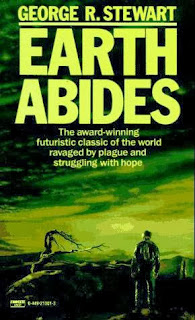
Written in 1951 by George R. Stewart, Earth Abides describes the end of civilisation by way of a deadly pandemic. The main character is an intellectual, used to observe rather than do, therefore he gains comfort in the idea of observing the end of the world. He is immune to the disease, as are few others, and so he becomes not only the observer, but the patriarch of a whole new tribe of people.

The pace of the storytelling is rather slow and the story itself spans several decades, until Ish dies of old age. The book is clearly well written, and I would say well thought, as well, but I take issue with Ish's character. He is proud of being an intellectual, of reading books, he worries all the time about the fate of civilisation, but he really does nothing to share his knowledge or do something of what he is thinking of. I know that's a trait I share, unfortunately, but his level of passivity is insane.

If at the beginning of the book I was relishing the description of the single guy finding ways to survive, both physically and mentally, then liking the way the little group of people was growing into a tribe, then I kept waiting for something else to happen. Instead, they all become complacent, living in houses they didn't know how to maintain, using products from abandoned shops they did not care to learn how to make, forgetting how to read, and so on. The biggest calling of an intellectual is to continually learn and teach. Instead, in what I see as great hypocrisy, Ish is merely content to be slightly more learned than the people around him, thinking to himself like he was reading from the Bible, even if he considered himself as an atheist rationalist, then having hopes that his child will grow to be an intellectual and spread it around, as he was doing none of that. He just complained endlessly about how stuff should be! That was infuriating.

Perhaps that is why it took so long to finish the book, as the ending felt horrifying and even insulting to me: people living like the old American indigens and caring not one bit of the immense body of knowledge that came before them. Perhaps what was worse is that this scenario seems very plausible, too.

What was refreshing (if you can use this word for a book that is 60 years old) is that there were no depictions of warrior groups roaming the land, looking for slaves or whatever, or any other type of antagonistic situations that required heroic violent response. It seems to me that this is almost a requirement in modern apocalyptic sci-fi, if not in most of it.

The style of the writing and the thoughts of its main character are a bit dated, but not terribly so. Electricity is not really useful for much other than lightning and maybe listening to radio, so they don't feel they need to maintain it one bit. Women are not as learned or smart as are the men, but that's OK, because they are women. It is normal for some people to not know how to read. A man can decide for another what is best, just because he thinks he is smarter, and it is only civilised to let them choose for themselves and completely optional. Buildings are mostly wood, so a big fire would burn a town to nothing. And so on and so on.

I can't put my finger on it, but there is something 50ish about the mindset of the lead character that definitely feels alien to me now. Perhaps the idea that, even if he were to make the effort to teach the children to read, the only books that would be of use would be technical or science. That's an incredibly weird point of view to find in a fantasy literature book.

Anyway, as one D.D.Shade lamented in a 1998 review of this book: When you're talking to someone you just met and you discover they 'love' science fiction, and you ask with great anticipation if they have read Earth Abides, the answer is "No, should I?". I agree with the man. The book should be read and should be known, as a classic of the genre and a reminder of how "the first Americans" thought about these things. Don't expect to go all "Wow!" while reading it, but as it stands, there are few books that are as thorough about the end of civilisation as this one.

I've read Legends of Earthsea and so I knew a little bit who the characters were and what the story was supposed to be. And still I got confused on what exactly had Tales from Earthsea in common with the books I remember. First of all it is a loose adaptation of the third book, so if you don't know who Sparrowhawk or Tenar are, you are out of luck. Also the Nipponification of the characters makes things a bit lame; for example Tenar is a kind and spirited woman, but completely helpless and always in need of a male to come rescue her. Even Sparrowhawk, the greatest mage in existence, is easily captured or fooled. Then there is the repetition of the same bullshit that without death there can be no life, the reason that Cob needs to be defeated. It's such a Japanese way of accepting fate that has nothing to do with the Le Guin books.

Basically Goro Miyazaki turned this beautiful fantasy into a moralizing piece of crap, where the biggest sin is that one wants to avoid death. The anime is missing the point of the books, it's completely unintelligible without reading those books, and finally does nothing for the viewer. Just read the books and enjoy the story. Or at least see the mini series ecranization of the first three books, with Shawn Ashmore as Sparrowhawk and the beautiful Kristin Kreuk as Tenar. This anime, unfortunately, had nothing working for it except the excellent animation.

Just to understand how bad this film is, I went to Imdb to rate it and I noticed that I had already rated it before. So I have seen it already, but forgotten about it. That's how unmemorable it is.

A lot of the political discourse these days relates to the difference between democratic and non-democratic systems. More close to home, the amount of choice a government allows and - do not forget that part - demands from the individual. The usual path of such discourse is either "We let you do what you want!" or "We won't allow people do what you don't want!". I am telling you here that there is only a difference of nuance here, both systems are essentially doing the same thing, with top-to-bottom approaches or bottom-to-top. Like with the Borg in Star Trek, there is a point where both meet and make definition impossible.

My first argument is that the ideal democracy encourages personal freedom as long as it doesn't bother anyone else. That makes a lot of sense, like not allowing someone to kill you because they feel you're an asshole. Many people today live solely because of this side of democratic society. But it also means something else, something you are less prone to notice: you are demanded to know what everybody affected by your actions would feel about them. Forget the legal system, which in its annoying cumbersome way is only a shortcut to the principle described before. This is what it means, people: know your friends, know your enemies, join up! Otherwise you will just offend hard enough somebody who is important enough to make it illegal.

The non-democratic societies function like the all mighty parent of all. Under such governorship, all individual are children, incapable of making their own choices, unless supported by the whole of society or at least a large part of it. That's terribly oppressive, as it lets you do only what is communally permissible. But it also allows you the freedom of ignoring the personal choices of others. You don't need to know anything about anybody, just adhere to a set of rules that defines what you are allowed to do. It's that easy! That's why the system is so popular with uneducated people. Or maybe I should say lazy, to involve also those super educated people who end up supporting one radical view or another because it is inconvenient to find a middle ground compromise.

I am a techie, as you may know, so I will reduce all this human complexity to computer systems. Yes, I can! The first computer systems, created by scientists and highly technical people, were almost impossible to use. Not because they didn't let you do stuff, but because they let you do anything you wanted, assuming you were smart enough to understand what you were playing with. Obviously, few of us are really that smart. Even fewer want to make the effort. This is an important point: it's not that you are stupid, that you didn't read the manual, or anything like that. It's a rather aristocratic reason: you don't want to, don't need to, you expect comfort from the people who give you a complicated piece of machinery to operate. I mean, if they are smart to build one, why can't they make it so easy to use that a child could do it? (child sold separately, of course)

The answer to these complex UNIX systems was DOS, then Windows, then IOS. Operating systems increasingly dumbed down for the average user. Now everybody has a computer, whether a desktop, a laptop, a tablet, a smartphone or a combination of these. Children have at their fingertips computers thousands of times more powerful that what I was using as a desktop in my childhood, and it is all because they have operating systems that allow them to quickly "get it" and do what they feel like. They are empowered by them to do... well.. incredibly idiotic things, but that is what children do. That's how they learn.

You get where I am getting at, I guess. We are all children now, with tools that empower us to get all the information and disinformation we could possibly want. And here is where it gets fuzzy. The totalitarian systems of yesterday are failing to constrain people to conform to the rules because of the freedom technology brought. But at the same time the democratic systems are also failing, because the complicated legal systems that were created as a shortcut for human stupidity and lack of understanding of the needs of others completely break down in front of the onslaught of technology, empowering people to evolve, change, find solutions faster than antiquated laws can possibly advance. The "parents" are in shock, whether biological ones or just people who think they know better for some reason.

Forget parents, older brothers can hardly understand what the youth of today is talking about. Laws that applied to your grandparents are hardly applicable to you, but they are incomprehensible to your children. The world is slowly reaching an equilibrium, not that of democracy and not that of totalitarianism, but the one in between, where people are not doing what they are allowed to, but what they can get away with! And that includes (if not first and foremost) our governors.

This brings me to the burden of choice, the thing that really none of us wants. We want to be able to choose when we want to be able to choose. And before you attack my tautology, think about it. It's true. We want to have the choice in specific contexts, while most of the time we want that choice removed from us, or better said: we want to be protected from choice, when that choice is either obvious, difficult to make or requiring skills we don't have. That is why you pay an accountant to hold the financial reins of your company, even if it is your lifeblood, and you trust that that person will make the right choices for you. If he doesn't, your life is pretty much forfeit, but you want it like that. The alternative is you would understand and perform accounting. Death is preferable.

You know that there are still operating systems that allow a high level of choice, like Linux. They are preferable to the "childish" operating systems because they give you all the options you want (except user friendliness, but that bit has changed too in the last decade). The most used mobile operating system nowadays is probably Android and if it not, it will be soon. It swept the market that Apple's IPhone was thought to master because it gave everybody (users and developers) The Choice. But the off the shelf Android phone doesn't allow that choice to the average user. You have to be technically adept first and emotionally certain second that you want to enable that option on your own phone! It's like a coming of age ritual, if you will, the first "jailbreak" or "root" of your smartphone.

How does that translate to real life? Right now, not much, but it's coming. It should be, I mean. Maybe I am overly optimistic. You get the accountants that find loopholes to pay less taxes, the lawyers that find the path to getting away with what normally would be illegal, the businessmen that eskew the rules that apply to any others. They are the hackers of the system, one that is so mindbogglingly complex that computer science seems a child's game in comparison. If you mess with them, they quickly give you the RTFM answer, like the Linuxers of old, though.

The answer: make the system user friendly. Technology can certainly help now. There will be hackers of the system no matter what you do, but if the system is easy to use, everyone will have the choice, when they want it, and will not be burdened by it, when they don't want it. People talking to find a solution to a problem? When did that ever work? We need government, law, business, social services, everyday life to work "on Android". We need the hurdles that stop us from enabling the "Pro" options, but they must not be impossible to get through. Bring back the guilds - without the monopoly - when people were helping each other to get through a problem together. Liberalize the banking and governmental systems. Forget about borders: just "subscribe" to a government, "like" a bank, "share" a life.

You think this is hard, but it is not. You can survive in an old fashioned system just as much and as well as you can survive in real life without using a computer. You can't! You can dream of a perfect house in the middle of nowhere with the white picket fence, where you will be happy with your spouse, children, dog, but really, that doesn't exist anymore. Maybe in a virtual world. Where the spouse will not nag, the children will actually love you instead of doing things you don't even begin to understand and the dog will never wake you up when you need to sleep. Use the tools you have to make your life simpler, better, depth first!

I assume some people would give me the attitude that is prevalent in some movies that try to explore this situation: "you want to escape reality!" - Yes! Who doesn't? Have you seen reality lately? "you want to play God!" - Yes! I like playing and I would like being God: win-win! And if I cannot, I will get real serious and not play, just be! Is that OK? "this is fantasy, this cannot be!" - Join the billions of dead people who thought the same about what you are doing daily without thinking about it. "You are an anarchist! The government as it is today knows what to do!" or "Allah/Jesus/Dawkings know best!" - no, they don't! And if they knew, they wouldn't tell you, so there.

It all comes to dynamical systems versus static ones. You don't go to the web to search for things and find what you were actually looking for because there is a law against sites hijacking your searches. It is because people want it enough so that a service like Google appeared. You can still find your porn and your torrents, though.

Consider every option you may possible have as a service. You need the service to be discoverable, but not mandatory or oppressive in its design, it has to be easy to use. You want to be able to find and use it, but not for it to be imposed on you. A good example for this is copyright. A small community of producers and a significantly larger one of intermediaries trying to leach on them are attempting to force a huge community of consumers abide to the (otherwise moral and reasonable) laws of paying for what you want and others worked for. The procedure is so annoying that people spontaneously organize to create the framework that democratizes theft. Someone is risking jail to film the movie in the cinema so you can download it free. Why is that? Because technology increases the dynamicity of the system with orders of magnitude. Another service is sex. Porn be damned, prostitutes don't stay on street corners anymore, they wait on the web for you to need them. Supply and demand. So the important point is what are you really demanding?

You know what you won't find on the web? Easy to use government sites. Services that would make it simple to interact with laws, lawmakers, local authorities, country officials. All similar attempts are notoriously bad, if at all present. Why is that? Because the system itself is obsolete, incapable of adapting. Built from centuries of posturing and politicking, it has as little connection to reality as a session of Angry Birds. And you may be enjoying the latter. They survived as long as they have because they were the best at one thing: limiting your choices. Even if you hated it, you enjoyed other people being as limited as you. But the dam is breaking, the water is sipping through, it will all vanish in a deluge of water and debris. It's already started, with peer to peer banks and online cryptographic currencies and what not. Why wait for it? Join the nation of your choice; if there isn't one you like, create one. Be God, be Adam, Eve, the serpent or any combination thereof - whatever you do, just don't be yourself, no one likes that.


I leave you with the beautiful words and music of Perfect Circle: Pet. Something so awesome an entire corporation was created to offer the ability for people to share the song with you, for free, even if theoretically it's illegal.
and has 1 comment

I can't emphasize enough how cool the video courses from The Teaching CompanyThe Great Courses are. They are in the format of a university course, but no one is there to take notes so the pace of presentation is natural, it is all recorded on video. No black or white boards, either, as the visualizations of what the presenter is saying are added later via computer. Most courses have from 10 to 40 lectures, all in an easy to understand language, but no trace of the ridiculous tricks and populist stupidities in TV documentaries.

This course - Mysteries of the Microscopic World, presented by Bruce E. Fleury - in particular is very interesting, as it discusses microorganisms in relation to human culture. Especially interesting are lectures 11 to 13, discussing the hideous pandemic of 1918, of which nobody seems to be talking or making heroic movies about or even remember, even if it killed from 50 to 100 million people. In comparison, first world war killed a measly 8.5 million. Why is that? Is it as Dr. Fleury suggests, that the pandemic was a horrible and completely unstoppable phenomenon from which no one felt they had escaped or in face of which there were no heroes? I find this almost as disgusting as the disease itself, that people would only want to document their triumphs.

Anyway, for an old guy, Bruce is a funny man. He is very eloquent and not at all boring, despite his fears. The course goes from explaining what microorganisms are, how they evolved, the perpetual arms race against other organisms, including us, how they influenced history and even how they were used in biological warfare, AIDS and even allergies, all in 24 lectures. I think a lot of information in this course is something unlikely for you to have accidentally overheard or to have been exposed to, therefore of high quality.

As an additional bonus, you get to understand not only the evolution of medicine, but of all the quack snake oil ideas that are periodically emerging in "naive populations", truly epidemics in their own right, and even the source of some of the most common sayings and symbols. For example the symbol of medicine has little to do with the wisdom of snakes, but more with the procedure to remove nematode worms from someone's flesh by wrapping them slowly around a stick.

All in all a wonderful course, created and presented by a guy who is clearly adverse to bullshit and who has read and has worked quite a bit to make it. Give it a try!

and has 0 comments
Happy New Year, everybody! A new year is starting and, with it, a lot of TV shows start and meet their demise. It is time to tell you what I've watched - as community service for you, of course :) - and what I think about them.


Let's start with the already described ones:

  • Doctor Who - The new season with Capaldi in the role of the 13th doctor has not started yet, but there were the 50th anniversary of the show, which pretty much saved Gallifrey and showed all the Doctors so far and even a bit of the new one, then the usual Christmas special, where Gallifrey saved The Doctor. Kind of a quid pro quo. Anyway, it seems to me that in less than 9 years they added at least 600 years to the venerable age of The Doctor. Soon he will become older than The Face of Bo, if he continues that way :)
  • True Blood - I will be watching the new season, but I don't have much hopes for the show now. It was good while it lasted, though.
  • The Good Wife - The old formula of the show started squeaking, as I was observing the last TV series post, so they cooked up something else. Alicia is leaving the company to form her own, to the dismay and hurt of Will, who is now intent on making her hurt back. A game of legal cat and mouse ensues (see what I did there?). It is a breath of fresh air for the show, but I don't know how much it can last. Will's character cannot maintain its value if he loses to Alicia in court all day.
  • Haven - the fourth season sees sheriff Carter from Eureka be a psychotic bad guy. Good for him. They finally defeat him only to find a very changed Audrey Parker. Parker and Carter sitting in a tree...
  • Southpark - Southpark had some very funny episodes lately. Not the best, but pretty cool.
  • Homeland - Season three was weird. High tension, quick turns of the situation, great acting. Unfortunately the characters themselves lost their charisma and empathy value. I had no idea why anyone did what they did, even when they explained it several times. Not that it is confusing, I just can't relate to the characters. The end of the season made me think it was the end of the show, but it seems there will be a fourth.
  • The Walking Dead - A plague, the Governor returning for a while and a lot of the characters leaving or dying. This can be good for the show, as some sort of renewal was desperately needed, but we'll have to see how it goes...
  • Game of Thrones - waiting for the new season. There is a lot of tension about Martin not writing his books fast enough. The show is going to catch up and then what?
  • Copper - Copper got cancelled. It kind of deserved it, though, after a boring and pointless second season.
  • Arrow - I spoke too soon. I kind of like Arrow. I have no good reason for it, but there are a lot of characters, beautiful women, weird magical stuff that has nothing to do with logic and they even added Flash in the series. What I am most happy about, enough to take it from the notwant list, is the return of Manu Bennett, who I noticed in Spartacus as being a very good actor.
  • Elementary - New dynamic. Lucy Liu's character is getting more and more attention as Sherlock himself starts to show all kinds of vulnerabilities and a human side. It works, I think, but they'd better not push it too much.
  • The Tomorrow People (2013) - Ridiculously good looking actors also have superpowers, while being hunted by an evil agency. I am glad the show changed almost everything else in this remake, but the show could use more logic in it.
  • The Legend of Korra - The second season ended in victory for the forces of good, naturally, but a bit better than it started. Korra seems to slowly mature. Really slowly.
  • Rewind - A strange move to cancel this show after its pilot aired. It was a promising one, even if the base concept was a bit too morally unstable.
  • Serangoon Road - The first season ended and I had the feeling of loss and of wanting more that indicates I really liked the show and its characters. There are a lot more facets of the world in it to be explored and I eagerly await the second season.
  • Siberia - Siberia got cancelled and for good reasons, I think. I stopped watching it anyway.
  • Sleepy Hollow - Magic, witches demons and American history. The concept could have gone in so many ways, all good, but they chose the melodramatic way.
  • The Bridge - Interesting show, but I wonder how they intend to continue it in the second season, since all the major story arches of the first one got completed.
  • The Originals - I am close to stopping watching it. It feels like Dynasty with vampires.
  • The Psychopath Next Door - I really liked how this started, but it seems the pilot got converted into a movie and that was the end of it. Too bad!
  • Under The Dome - I want to believe that King's story was better than this watered down, incoherent crap. I may stop watching it altogether.
  • Witches of East End - The show got a little darker, but only a little. New characters and connections appear, but not much of a show besides the eye candy.
  • The Last Witch - I liked the first episode, but there was no second. I really want this to be picked up for a series, but I don't know if it didn't or the plan to continue it later or what...

And the new or restarted shows:

  • Marvel's agents of S.H.I.E.L.D. - A show that combines the idea of superheroes that seems to stick nicely to the public with the one about a good government agency: S.H.I.E.L.D. Their purpose: to police the entire world in order to protect it from itself and contamination from alien technology. I can't possibly subscribe to the mission statement, but the show is decent.
  • Dracula - What started as a ridiculous concept caught up with me. Dracula is no angel, but he fights an even darker agency: the order Draco. Everybody is a bit conspiratorial and over dramatic, but I like the show so far.
  • Killer Women - An US remake of an Argentinian show, it features Tricia Helfer as a Ranger! She uses her womanly powers to fight crime, alas. I really hoped for a better premise. I would predict the show is going to be cancelled pretty quickly, as woman police shows usually get, but I could be wrong, seeing that is a remake of another show, so at least part of it should stick to audiences.
  • Misfits - Misfits ended. It was a nice show, but a little too pointless. I will still recommend you watch the first seasons.
  • Ripper Street - This show was also cancelled, after just two seasons. Me and an entire bunch of people protested against its cancellation because it was a good show! A bit inconsistent, true, but good actors and a nice starting point. Bring it back, you wankers!
  • Wizards vs Aliens - Yes! The second season of the show features yet again wizards taking a stand about the alien hungering for magic: the Necross! There is even an episode about the world where magic originates, where the wizard kid and the female Necross (there transformed into a woman) live together and have a child. Is that weird or what? :)
  • Sherlock - The third season of the British reinvention of the Holmes mythos just started. I am going to watch it, but as you may remember, I don't particularly like the way they did it, even if it stars Benedict Cumberbatch.
  • Ghost in the Shell: Arise - I watched the second episode of this Japanese anime series. If you don't know what Ghost in the Shell is, you should start watching it immediately. Arise is just a reinvention of the series, with better graphics and a change in technology and character stories. It doesn't seem to be as poignant as the films or the Stand Alone Complex series, but it may change in the future.
  • A Young Doctor's Notebook and Other Stories - The second season appeared! Just like the first, four episodes of 20 minutes each. This time the humor is almost not present, instead terrible despair. The main character's ... err.. character is so awful and pathetic that even the viewer has to loathe him. His older alter ego is prepared to forgive him, only even he can't! A very good show, with a completely different structure and feel from anything I've seen so far.

There have been a lot of new shows lately, but many of them I just skimmed or downright refused to even try.

and has 0 comments
I am writing this post because I sometimes get fed up with all these self-righteous people who explain to me, condescendingly of course, what "real" means and how important it is compared to what I may be doing, which has a lower value of reality, often approaching zero. I am hearing that texting or using an instant messenger is not carrying a conversation. That love is attention and that I should always focus that attention on one thing or another (mainly on their person, though). I watch too many movies instead of going out to parties, I read books instead of talking walks, I throw myself into an online game or some news item instead of noticing to my wife's needs, I stay indoors instead of going out. You see, for these people, going outside the home, physically interacting with other humans with no hope of escape and watching events unfold with your eyes (smell them with your nose, touch them with your own skin) rather than seeing them on a screen is what is "real". Well, I am here to tell you all: bullshit! There is no such thing as real since the time a brain was invented.

Now, I could be as condescending as these people are and explain to you how neurologically a brain is trying to project the world, as perceived by the senses, so that it can fit in the head and can simulate events before they happen, thus leading to informed decisions. Or I could bore you to death by demonstrating that two people can never ever have access to the same reality. I won't do that, though :) What I will do is just give you some counter-examples that will prove, I hope, that there was never a common reality to begin with and that technology only enables a process that is too old and too human to ever stop.

When I was a child my parents were thinking that going out would be good for me. I, however, wanted to stay indoors and read books. Not on a PDA or on a computer, but on actual paper, the only things that were then available to me in Romania. They would talk to me, you see, ask me to come to lunch, or ask me a question or try to interact with me for some reason or another. I, however, was lost 20000 leagues under the sea or on some alien planet or in some cave, running from a crazed killer. I couldn't hear them. More, I didn't really want to. They could, of course, smack me in the head and that would certainly feel more real than what was in the book, but does that mean it was not real to begin with? And I will have to say that, even if some written scenario was complete fantasy, I was interacting with it, remembering it, training my mind on it, maybe even believing it could be real or that it was real already. The contents of the book were changing my personality and my knowledge and, on any further "real" interactions with other people, changed them a bit, too. It's the same thing as believing the things said in an electoral campaign and then changing your life's course to account for that. At least sci-fi has a small chance to happen!

My point is that the process of losing myself into a parallel world, whether of my own creation or somebody else's, is something that people have been doing for a long time. Technology is not creating this phenomenon, it only enables it.

And then there is the hypocrisy. Some fantasy book is something not real and I should do something that counts, you say, but you don't have the balls to say the same thing to a religious nut who advocates prayer every Sunday (or perhaps a small war). That would be insensitive to their beliefs, you say then. They have the right to lose themselves in a complete fabrication because they are not the only ones. There is a whole pack ready to tear you to bits if you try to stop it. I have news to you! The readers of books may not be a tight knit pack, but their set includes the set of people who read religious books and believe in them, too. The book readers group is a lot bigger, if a less ferocious, tribe. We are not to be feared, but that doesn't mean you are not insensitive to us.

So now it is easier to watch a movie or a series to become lost in some fantastic universe. It is easier to split communication into small text bits that are sent only when and where you want them. It is a lot easier to imagine you are in a circle of friends, even if you've never actually met most of them. Is that bad? It's like accusing the inventor of writing of making people listen less to other people speak. Don't get me wrong, I am not advocating replacing the old and tried methods of human interaction with technological means; I am instead revolting against attempts to limit the methods I find best for me.

And literary fantasy is not necessarily the stuff that shapes your thoughts for a while. It can be something acutely technical, like a recipe for cake, or a legal contract, or a video explaining how to do something. Neither are "real", they are just information. Then comes your decision to bake the cake, memorize the recipe or just forget the whole thing. And when has anything you've read in a legal contract have anything to do with reality?

I believe that all this propaganda for the concept of reality - itself just a fantasy of the accuser - is used to hide a more brutal thing, one that is harder to accept. I submit to you that when someone prefers to read a book or watch a movie rather than talk to you, it is because you are less interesting. When children prefer to text on their smartphones while ignoring their parents, it's because their parents are boring. When someone prefers indoor activities to outdoor activities, it's because the things you did outside when you were young, the things that made you feel healthy and proud, are becoming less and less relevant. A conversation is two-sided only and continuous only if both participants are incredibly interesting, otherwise there are other options now. Eye contact doesn't communicate the amount and quality of information that makes it worthwhile anymore. And love, the ultimate feeling, the thing that makes the world go round, the stuff of dreams and fairy tales, love just has to be of a certain quality nowadays before it becomes attractive. Reality is boring, it's the low bandwidth information flow of yesterday, the only people living almost exclusively in it are termed savages and peasants and other derogatory terms that you don't want attached to you. Be Zen! Be aware of and absorb everything that is happening to you, instead of choosing the things you want to see and hear and not smell. What pretentious crap!

Learning is now multithreaded, a web of fantasy and fact that just comes at you from all directions and that needs you to determine at every step how reliable, interesting or "real" it is. Other people are just data points and tools to help you achieve goals. Friendship is distributed. Identity is multiple and depends on context. People choose to live in fantasies now, because they can do it easier and better than before, when they still would have chosen it, but they didn't quite knew how. There is an app for everything because we thought of it first, someone created the app and people find the need to use it.

Technology does not ultimately change humanity in unwanted directions because technology has no desires. If humanity changes - or gives technology desires :), it is because it chooses so. It might be a bad choice, but it's a choice nonetheless. And people that find themselves overwhelmed by that choice should refrain from trying to rebrand past as reality.

and has 0 comments
There are situations where a program would display an error of the type "Libeay32.dll Not Found" or "This application failed to start because libeay32.dll was not found. Re-installing the application may fix this problem." I had this problem with SpeedFan, for example, which would display this error on startup, but then start without a hitch after closing the popup. There are a lot of solutions on the net, but the safest and quickest (for Speedfan and probably most other programs) is to do the following:
  1. Obtain a copy of the libeay32.dll file
  2. Copy the file in the Speedfan folder in Program Files
  3. Restart Speedfan
. You might prefer to reinstall the offending program, which is probably the best general solution, but you could lose some custom configurations or data or, as in the case of Speedfan, it might not work!

As for the obtaining, you probably have several copies of the library on your computer anyway. Just search for it in Program Files, I had a bunch of them and chose the one that was newest. You could copy the file thus found in Windows\System32, but that would not be the best idea, as it might interfere with all programs looking for the library, so it is safer to copy it only in the folder of the program that causes the error to occur.

For an explanation, I understand libeay32 is an OpenSSL library, something that is free, open source and used for Secure Sockets Layer - a protocol widely used on the Internet. Therefore you will find all kinds of versions, in all kinds of bundles. It might even be a malware, in some cases, so make sure it isn't before copying it around ;) Also, the reason why Speedfan would start anyway, even without the library, is that it was used only in the context of sending secure mail, a feature I have never used.

and has 0 comments

I read about Dark Universe online, in a "best" sci-fi book list from somewhere. Richard Dawkins recommended it as a very good book and one of his favourites. I can see why the book would appeal to Dawkins, perhaps he even read it when he was a child. The idea is that the book is classical pulp fiction; the characters are simple and undeveloped, the logic strained and the science only consistent with the times in which it was written. At first, when I started reading, I was captivated by the world of people living underground after a nuclear apocalypse, but then I started getting more and more annoyed with the leaps of logic and superficial characterisation. I thought it was a book written by a teenager, like Eragon maybe, but instead it was written by a grown man in the 50s. When I learned about this I understood more of why the book existed at all and why people seemed so... stupid and onetracked. The ending, something that almost offended me, not by its quality - which wasn't good to begin with, but by its implications, is classic 1950 "scientific" thinking. The hope of humanity as small minded arrogant assholes.

Bottom line, it is a simple and easy to read book, in a bad way. The science for it is lacking, the characters are simplistic and the plot classic pulp (prince and princess kind of crap). Too bad that a good initial concept was wasted by a mediocre writer in a mediocre time.