and has 2 comments
It is time for another exhaustive list of TV series I have been watching. Some are great, some are horrible, but the moral of the story is I just can't stop :) Here it goes:
  • Caprica - A spin-off from Battlestar Galactica, it showed a lot of promise, tackling the culture of the twelve colonies, issues like emergent AI and virtual life. However, it did not appeal to the public so it was cancelled. I am yet to see the last episodes from the series, but I expect the quality of the show to have plummeted long before the official news of the cancellation. When a network exec puts limits like "get me audience or die" people just lose interest in doing something and it quickly becomes a self-fulfilling prophecy.
  • Doctor Who - one wacky adventure after another, I still watch this British series. What it lacks in budget it compensates with weird plot lines and original writing. Quite refreshing.
  • Eureka - a silly sci-fi comedy, I would have expected it to die after a few seasons. Alas, people like easy, silly, pointless shows and only resent the ones that makes them think. Season 4 is expected to resume in July 2011.
  • House MD - I am kind of stuck watching this less and less medical series, because my wife likes it. I am bored by the plot, characters and almost everything in it except the occasional interesting medical fact. I hear season 8 might be the last.
  • Criminal Minds - some episodes are pretty stupid, others are brilliant. The exposure of the minds of serial killers through behavioural analysis is a great subject. Alas, they put too much focus on the procedure and too little on the actual principles behind the work of the FBI unit. Don't fret, though, a spin-off with Forest Whitaker as the lead of another crime fighting group. Unfortunately, the joint episode from Criminal Minds that shouls have presented the new characters was weak and the new team pathetic.
  • Southpark - this animation comedy series has its bad moments, but usually it is exceptionally funny and making fun of recent events.
  • Dexter - the show keeps holding strong, even if they kind of drifted from the perfect quality of the first seasons. I hear season 6 might be last, even if the fourth book in the Dexter series, Dexter is Delicious, is now available. Lucky for the TV series, they only got inspiration from the books which were not of such good quality as the show.
  • Big Love - interesting story about a mormon family trying to maintain their plurimarital beliefs in the face of adversity from goverment and other mormons alike. The 5th season is to start soon, but it is also the last. It kind of went bad from the third one, anyway.
  • Fringe - I am yet to watch the episodes from season 3. It is a pretty dumb show, so people like it. I am waiting for a period in which I have nothing to do in order to watch it.
  • True Blood - I like True Blood! It's not the vampires, but the feel of the backwater town that is plagued by all kinds of supernatural creatures. I think the show did great, but lately it kind of stuttered. Season 4 is to start somewhere in June
  • Californication - luckily, father Christmas brought us two preair episodes from season 4 which should have started next year. I still like the show, but it is a far cry from the greatness of the first season, during which I wanted to make a son and name him David Duchovny.
  • Breaking Bad - is it good anymore? The show started great and I did watch it religiously, but it does seem to get less and less interesting. It's a crystal meth male version of Weeds.
  • Secret Diary of a Call Girl - Billie Piper could not have been more perfect for this series. She was delicious from the first time I saw her in that silly video clip of hers. The show was sexy, interesting, and will continue with a fourth season, which is said to be last. Why, God, why?!
  • Entourage - this series is another television gem. It features the Hollywood adventures of a talented actor and his close childhood friends. The show managed to maintain a consistent positive feel for five or six seasons, which made it both great and original in this world of TV drama. The last seasons, though, went for a dark weird vibe and the eigth season will be both short and the last. A feature film is in the works, maybe, but it doesn't matter, since the original feel is pretty much destroyed.
  • Stargate Universe - Yeah, finally a Stargate show that takes itself seriously! Or so I thought. When the audience didn't like the dark and gritty atmosphere, the black wind of show cancellation made everybody not give a damn. The result is a half baked show, troubled by financing and screenwriting issues. Poor Robert Carlyle did a marvelous job, but a single good Scottish actor can't save a show from its evil masters. The second season of Stargate Universe will also be the last.
  • Torchwood - A Doctor Who spin-off, it took a big break after an attempted publicity stunt. Season 4 is to start next year. Fun series, but when you take Doctor Who, you Americanize it and then you make it even sillier, you are bound to miss somewhere.
  • The Sarah Jane Adventures - another Doctor Who spin-off, directed almost exclusively towards young kids. Of course, I watch it and enjoy it very much.
  • V - the original miniseries was not great, but that is no reason to make a stupid show like this. It is about aliens invading Earth via subterfuge and manipulation and the human resistance. It quickly turned into a involuntary parody of World War II movies with dumb Germans and smart Allies.
  • Men Of A Certain Age - suprisingly good and serious, it is about three middle aged guys and childhood friends living their lives. It is funny, but deep, with characters that feel real and jokes that really make you think and smile. Way to go, Ray Romano! Season 2 just started.
  • Weeds - the show just ended its sisth season. The seventh should be its last. Not even the babeliciousness of Mary-Louise Parker could save the last season, which was boring and kind of pointless. Started so well, though.
  • The Good Wife - it is a lawyer show, mostly directed towards women, but I like it. Characters are complex enough, the law cases feel real and the plot is interesting.
  • The Walking Dead - woohoo! Zombie series! Also made after comic books, so they can't fail too much. I like it, but since it focuses on the personal drama of the survivors and not the survival itself, and since the zombies are slow and ridiculous... meh! :)
  • Shattered - Canadian show starring Callum Keith Rennie, which you may know from Battlestar Galactica, it is about a cop with split personality disorder. Not very realistic, with a 70's feel to it, even if it is supposed to take place in the present, but I watch it nonetheless. I wonder if there will be a second season to it.
  • Haven - supposedly based on a Stephen King short story, it is basically a mashup between Fringe and Twin Peaks. It's worse than both, but it is easy to watch when you shut your brain down.
  • Rubicon - The wife watches this, I can't. It is like somebody accidentally dropped a bit of Lost in Nikita, but also removed the hot chicks.
  • Royal Pains - an easy medical slightly-comedy show. Started funny, now it's just boring. I will tell you when it's over.
  • Identity - British police drama that had some potential. The Brits cancelled it after it's first season, but the ABC network is said to want to make their own series.
  • Lost Girl - Canadian show again, this time a sort of supernatural thing with a hot bisexual chick that is also a succubus as the lead. Buffy like, nothing serious, but at least it's sexy.
  • Nikita - Nikita is now an American-Asian, still bad-ass and with Michael wrapped around her little finger. Pointless show, really.
  • No Ordinary Family - a family of super heroes! What could be cooler? I stopped watching it after the pilot episode.
  • Better with You - my attempt to watch something really easy with the girls, a show with background laughter and stuff, it's about three couples of different ages and their developped manierisms. Instead of actually analysing the causes and finding solutions, though, they just focus on the inevitability that all comedy American couples look and sound the same in their age group. Yuck!
  • Pioneer One - this is a show that is created by an independent studio (read: two guys in a garrage), freely distributed via Bittorrent (legally) and financed through donations. For 20000$ an episode, it is pretty cool. I donated some money since I really want this to work. Don't expect a master-piece, but I personally enjoy it and await the release of the third episode.


Phew, that's about all. But there are also the shows that I intend to watch! :) Here is the list:
  • Terra Nova - a show that is supposed to start in the fall of 2011. The synposis sounds kind of ridiculous, but hey, it's sci-fi!
  • Tilda - an HBO comedy about two blogger women journalists: Diane Keaton and Ellen Page. Both are annoying, but good actresses, and HBO does good shows. Let's see how it goes.
  • Criminal Minds: Suspect Behavior - I mentioned this show as the spin-off from Criminal Minds. I don't hold high hopes for it, though, based on the episode that presented the new team.
  • A Game of Thrones - I've read the books and they were great! I predict the show will be epic, since the books themselves were detailed, complex, with great story and a bit of fantasy as well. I can't wait for the show to start.
  • Falling Skies - aliens are attacking, again. I wonder if they started this show to finally bury V, which sucks. However, how much better can another show be when the plot is that an advanced technological race comes to Earth to occupy it. I mean, this dump?!


Ok, now it's over... or should I mention the anime series I am watching as well... how about the web series? Hmm... :)

and has 0 comments
There are visionaries today that are capable of describing the future, as they see it. If it is close to the actual future, they get to be called futurologists. Of course, one will jump up and say that futurology has a definition and it is an art or a science that has nothing to do with vision, but I say that this is exactly what it is: guesswork. Guessing can be facilitated, however, by studying trends, staying current with new technology and thinking ahead on the needs that people have and will have in the future.

So how come no one is really good at it? How come people said in the past that by now we would get to Mars and have free energy and the likes? The reason is simple: because we can, but we won't! Just like people walking on the street and witnessing a robbery or a beating just stay and watch, but don't act, we are a world of diffuse responsibility. Nobody is responsible, everybody is to blame. But it's not true. I am responsibile, and you are; we make the future, we are the people, we are the ones that DO anything and everything.

So what is the error of futurology: they assume we would do what we can, when in truth we only do what we care. My New Year's resolution is to care, see where it takes me.

I've just finished watching episode two from the first season of Pioneer One, a sci-fi show made by amateurs, financed by donations and freely downloadable via Bittorrent. That is just fabulous! An episode is done with 20000$ and they need about 40000$ more to finish the last two episodes of the series.

I thought of this kind of system myself a year or so ago as I was observing that almost all movies and shows I watch are made by Americans, through gigantic media outlets that are only interested in profits and cancel any good show on the basis of money alone. I was wondering: where are the people that would be to TV what bloggers are to printed press? Of course, writing an article in a free public place like Blogger is a lot simpler than making a movie, but the idea is there. Mangakus do it all the time, in the US the comic book is back, why not TV shows?

The series is really good for the money that went into it. Except for some clueless actors that play very small parts, the people involved act decently and the atmosphere of the show is powerful and enticing. The dialogue is also strangely good, as I am used to clichees being sprouted in scenes of a certain type and when that doesn't happen, I have an eery feeling of unreality!

Pioneer One is not the only show like this. There is a network, called Vodo, with the motto: We love free! that helps distribute a lot of these Creative Commons licenced films and shows. I really want this to work. This gets the money from people interested to watch and gives it to the creators, rather than some vampire distribution network.

On that note, I would like to also talk about another TV show that is about to appear, called S.T.A.L.K.E.R. Yes, indeed, it is a TV series inspired by the game with the same name, which in turn was inspired by Roadside Picnic, by the Strugatsky brothers. The show is made by the Ukranian company that made the game and you can follow the progress of the series by going to its official site. The S.T.A.L.K.E.R. show would not be freely released, but at least it is not part of the official channels for TV distribution. The story itself sounds cool and the S.T.A.L.K.E.R. universe counts about 40 books already (in Russian, unfortunately, but give it time).

It moves slowly, but surely. I am convinced that in a few years people will make and distribute work via the Internet, directly sponsored by the people interested in their creation. All the salesmen in the middle will just be bypassed and creators will be controlling the cultural market rather than distributors. It only feels natural: if you distribute something under a Creative Commons licence, there can be no piracy :) So there, what I've always said comes true: the death of piracy is synonimous with the death of mammoth distribution companies and all their bullshit.

and has 2 comments
Here is the link for the article, written by Brian Hayes, who argues that programmers should rather communicate peacefully, rather than fight each other over the language they are using. In the end it didn't really reveal anything grandieuse, but his post was detailed and funny and nice to read.

Update: I've thought about the article and I feel I have to add to this post.

First of all, I have to admit, as the author of the initial article admited that he is a Lisp fan, that I like the C-like structure of programs (minus the pointers :D). Actually, I would go so far as to occasionally dream of building an application which would convert Python and F# and Lisp and all those wacky languages into a semicolon/curly bracket version that I could use, then convert it back to their normal format before compilation or use. I agree with the author that the syntax itself is not very relevant to the language, but it is relevant to the users. I can "read" C#-like code much easier because by now I am fluent in C#. I believe that a nice option is to have the kind of functionality I am describing: something that would not change the language, but would slightly change the syntax so that someone can read it more easily.

Second of all, I am amazed that something that started as a nice introduction to an idea would continue with an admission (of guilt >:) ) that the author likes Lisp and then abruptly end. He didn't mention anything about the .Net idea which tries to unify a lot of programmaing languages under an intermediate compiler language. This brings the great opportunity to use a library written in a language with an application written in another. If that is not a good idea, I don't know what is!

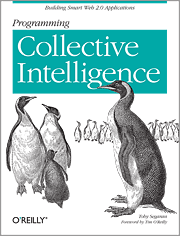
Programming Collective Intelligence is easy to read, small but concise, and its only major flaw is the title; and that is because it is misleading. The book touches quite heavily on using collective information and social site APIs, but what it is really about is data mining. It may not be a flaw with the majority of readers, but personally I wouldn't care about the collective, the Facebook API or anything like that, but I was really interested in the different ways to analyse data. In that sense, this book can be taken as a reference guide on data mining.

Each algorithm and idea is accompanied by Python sources. I personally dislike Python as a language, but the author afirms he chose it intentionally because the algorithms look clear and the source is small, with its purpose unhindred by many language artefacts. The book was so interesting, though, that I plan (if I ever find the time :( ) to take all the examples and do them in C#, then place them on Github.

The book covers classification and feature extraction, supervised and unsupervised algorithms, filtering and discovery and it also has exercises at the end of each chapter. Here is a short list:
  • Making Recommendations - about the way one can use data from user preferences in order to create recommendations. Distance metrics and finding similar items to the ones we like or people with similar tastes.
  • Discovering Groups - about classifying data into different groups. Supervised and unsupervised methods are described, hierarchical clustering, dendograms, column clustering, K-Means clustering and diferent methods of visualisation.
  • Searching and Ranking - it basically explains step by step how to make a search engine. Word frequency, word distance, location of a document, counting methods, artifical neural networks, the Google PageRank algorithm, extraction of information from link text, and learning from user clicks can be found in this chapter.
  • Optimization - simulated annealing, hill climbing, genetic algorithms are described and exampled here. The chapter talks about optimizing problems like travel schedules and the example uses data from Kayak.
  • Document Filtering - a chapter about filtering documents based on preferences or getting rid of spam. You can find here Bayesian filtering and the Fisher method.
  • Decision Trees - a very interesting method of splitting information items into groups that have a hierarchical connection between them. The examples use the Zillow API
  • Bulding Price Models - k-Nearest neighbours, weighted neighbours, scaling.
  • Advanced Classification - Kernel Methods and Support Vector Machines. This is a great chapter and it show some pretty cool uses of data mining using the Facebook API
  • Finding Independent Features - reviews Bayesian classification and clustering, then proposes Non-Negative Matrix Factorisation, a method invented circa the late 90s, a powerful algorithm which uses matrix algebra to find features in a data set
  • Evolving Intelligence - bingo! Genetic Programming made easy. Really cool.
  • Algorithm Summary, Third Party Libraries and Mathematical Formulas - if you had any doubts you can use this book as a data mining reference book, the last three chapters eliminate them. An even more concise summary of the methods explained in the book, listing every math formula and obscure library used in the book


Conclusion: I really loved the book and I can hardly wait to take it apart with a computer in hand.

and has 0 comments
It's been a while since I've last posted some music. This is not the kind of music I would listen to, mostly, but it is all Japanese music, 5 seconds of each band, a lot of bands. I thought it was a nice overview of a type of music I know almost nothing about. Enjoy!

and has 0 comments
Ok, so I had to say something about Julian Assange and Wikileaks. I will not speculate on the probably bogus rape arrest warrant for Assange (oh, it seems I did :) ), but instead focus on one of his quotes: "If governments would prefer to not have such information surface they have two choices: don't engage in wars that even their own military employees find reprehensible, and don't rely on secrecy as a method of governance.". Sounds like the old "Nothing to hide, nothing to fear" thing, used by so many people with power to justify their actions. Well, payback's a bitch, isn't it?

Looks like I am not the only one having this impression.

and has 0 comments

Here is an unsettling news: US and Indian filmmakers sign Hollywood-Bollywood deal. In my mind, this means outsourcing to India for movies just as good as the software coming from there, it means working together to control distribution and selection of movie material, coordinating moves so that the huge garbage spewing movie monster we now call Hollywood would have no competitor, ever.

Maybe I am just paranoid, but where are the Internet based movie-hacker studios that should have sprouted everywhere with low budget, but very cool films? Do they all stop at small stuff on YouTube and then get a job in fast-food? Where is the "free market" competition in entertainment?

and has 0 comments
The Void Trilogy ends with The Evolutionary Void in a typical Hamiltonian way: completely off the scale science and fights, actions with galactic and universal implications and the bunch of special heroic people that lead the entire story to a climactic finish.

I couldn't wait for the last book of the trilogy to get out and I finally got hold of it, but more than a year had passed since reading the first two. Most of the characters I had to remember while reading the book, something that degraded a bit the reading experience. Take it as a hint: before starting a Peter F. Hamilton series of books, make sure they are all available before you start, as you can't let them out of your hands until you get to the end and the feeling of loss is horrible.

Now, about the book itself. The middle of the galaxy hosts an all devouring and unstoppable Void, inside which thought is the main law of physics and which feeds on the mass of the worlds outside in order to sustain itself. Basically, the heroes in the book are battling galactic cancer. The style of the narrative mixes incredibly advanced technology with an archetypal feudal heroic fantasy, bringing them flawlessly together at the end. Not everything makes sense, but then again, not everything could. Simple solutions to problems were available, but never explored, and some characters were popping in and out of the book stream like so many quantum fluctuations. But on the whole, it was a great reading, keeping me connected for the entire length and, unexpectedly judging by the Hamilton books I have read, with a good, satisfying ending.

Now, I plan on reading some non fiction books, then I will probably return to the Prince of Nothing universe. After that, who knows?

and has 0 comments
A while ago I wrote a post detailing how to install Windows XP on a laptop with SATA drivers without using any floppy disk. Today I had to do such installation again and I've met with some annoying errors.

The laptop was an Acer Aspire, so I did everything in my old post and started the computer. It is important to use the correct drivers, as in my case the installation met with a blue screen with code 0x0000007B. It was like it tried to use some of the SATA drivers I had loaded on my WindowsXP CD, but not the right ones.

After the installation went ok, Windows XP would not boot up, not even in safe mode. In order to check what the hell is going on (because the default behaviour is to show a blue screen and immediately reboot) you need to start the computer and press F8, then disable the automated restart in case of error from the menu.

The problem is that the laptop had "AHCI mode" enabled in BIOS. Apparently, Windows XP doesn't support this mode. Set it to IDE BEFORE you start installing Windows XP. After that, you can enable AHCI after you install some stuff and change some registry entries, but it seems XP doesn't really have much use of this mode of access anyway. Here is a forum discussing this, but I haven't got around to trying the things described there yet.

Good luck with your installation. I almost went for installing Windows 7. Phew!

Ok, I am working on the blog to make it more accessible. I've replaced the template, I made all changes in the template from javascript and CSS, not by editing it and I've removed many of the things clogging the site. Not the cats and flies, though :) The light (low band) version of the site is not working anymore. If you want just the content, you can open the RSS feed.

I would like to know what you are thinking about the new look and I hope I will find the time to write interesting posts.


I almost expected the guy to be Canadian. :) This series of fantasy books is a masterpiece of writing. Not only it is complex of plot and emotion, but the characters are many, diverse and (most of all) different.

So far, the A Song of Ice and Fire saga, written by American author George R. R. Martin, consists of four books, the first published in 1996 and the last in 2005. At least three other books are planned in this series. The plot is a historical fantasy, but one unlike the books I've read recently. The aspects of magic and otherworldiness are rare, the bulk of the writing being about the feudal world, with kings, knights, low borns, maidens and whores, thieves, rapists and murderers, plotters and honorable men. No wonder that, lacking a lot of special effects, the story has been selected as the basis for a TV series.

But what is more important than anything is that the writing is really good. The characters are all human, with needs, desires, qualities and faults. You can't help but empathise with them, only to suffer at the cruel fate the writer bestows upon them. Not one escapes unscathed from the malice and pettiness of other people or from shere bad luck. You get to like the characters, then Martin fucks them up. I really wanted to use a more elevated language here, but it's the truth: the world he depicts seems horribly real, not a fairy tale of valiant white knights and pure maidens, but of ridiculous people grabbing lustfully whatever life offers them as it is unlikely their fortune is going to last long.

For the bad part, though, I think the author went too deep, got himself responsible for a lot of characters that he must now move forward, in gruesome detail. The fourth book became so large that he had to split it. He did so by character and geography, rather than by time, so a lot of the characters were missing from the fourth book, A Feast for Crows, and left for the fifth, but acting in the same timeline. At the end of A Feast for Crows the author explains his decision to not just split the book in the middle with a "To Be Continued" ending, and hopes for a publication of the second half in a year. That was in 2005. Ahem.

A lot of people are a bit confused by the long wait for the fifth book. Martin keeps making promises that he doesn't keep and, in July this year, he announced that A Dance with Dragons is already 1400 pages long and 5 chapters close to completion. I hope he does finish it quickly enough, although that would only prolong my suffering anyway. I am sure the fifth book will be as brilliant as the others, but then I will have to wait another 5 years for the sixth. I know TV series usually have no plot, but at least they come weekly ;)

Bottom line: The books are great, I recommend them to any lover of fantasy or even historical novels. I can hardly wait for the TV series, A Game of Thrones, as well.

and has 2 comments
While waiting for the tenth book in the Malazan Book of the Fallen saga, I went and read Prince of Nothing, by another Canadian author, R. Scott Bakker. This is a three book story, first published in 2004, about what I can only describe as a psychopath, member of a rationalizing sect, going out into the world to protect the secret of said sect.

The book is well written, although not nearly as brilliant as the Malazan series. However the subject of it is very interesting, at least from my standpoint. It concerns a human that is trained in the ways of mental manipulation, rationale and causality, something akin to the Vulcans from StarTrek, but with a very human side to it, the one that pushes one to amass power and use their knowledge to manipulate.

No wonder that the "prince of nothing" is the central character in the books, but not the main character, the role being left to a sorcerer, a man that is at the same time keeper of arcane knowledge and the scorn of ordinary humans. I can't help but empathize with the guy: basically a geek in love with a whore, while a psychopath destroys his world with insidious manipulation. ;)

There is another central character to the story, an insane barbarian, like a tortured Conan, who is both terrifyingly strong and ridiculously fragile, both a mindless warrior and a brilliant strategist. He is also, like Achamian the sorcerer, an exponent of humanity.

Prince of Nothing is a very smart book, one that can only get better as the writing skills of Scott Bakker improve. Its assets are both a scientific approach to the human psyche and a veritable intrigue of arcane powers in conflict with each other on the background of huge masses of clueless people. The plot itself is similar to the story in the Berserk manga, at least its start, where the strong warrior chooses to follow the charismatic and ambitious leader only to his doom. The moral, as I saw it, is that while we choose to live our lives with eyes closed, we cannot in good conscience pretend to deserve control over what happens to us.

I hope the series, known as "The Second Apocalypse", continues, since Prince of Nothing raised more questions than gave answers and the plot really caught my attention. A nice book that I warmly recommend.

I haven't been the most present of hosts, but then again, I haven't seen much interest for the collaboration page, with its open chat and whiteboard. Therefore I replaced the link to it with the Plugoo chat. The blog desperately needs some refactoring, but not likely that it will happend soon.

and has 0 comments
I was posting a while ago about the first album from Hole's bassist, Melissa Auf Der Maur. I found that the music had a haunting femaleness in it and sounded pretty cool. She has recently released her second album Out of Our Minds and my opinion is... that they were! The songs are lame, like a really wattered out version of the first. Lady, if you don't feel like it, wait until the muse graces you with her presence, don't just write crap because you have a deadline. (Let me do that, ahem...)

Moving on to Linkin Park. A refreshing mixture of hip hop and rock, their first albums (Hybrid Theory and Meteora) made them famous. If you don't count the collection of remixes of their previous songs, their third album, Minutes to Midnight, was released after some time had passed (period during which Mike Shinoda was writing hip hop like crazy and the other guy... well, nobody knows what he did), had some environmental messages, some slow music, maybe some Michael Jacksony save the world songs... It pretty much sucked, but it was also ok. I mean, if you want to mellow down a little, just to try it on, why not? So now I got reminded of them when I accidentally saw Transformers and the theme of the film was sang by Linkin Park and called New Divide. It sounded kind of cool, something that resembled their first albums, so I got their latest album, A Thousand Suns, and tried it on. Long story short: it sucked. There were some cool songs, like Wretches and Kings, or Blackout, but overall, it was a whiny piece of crap. Dude! It's called ROCK, you're letting a Japanese hip hopper make you look like an emo kid trying to sing for the highschool prom.

Ok, now for some of the better songs on these albums:

Melissa auf der Maur - Out of Our Minds


Linkin Park - Wretches and Kings