Africa!
 Intro
Intro
 Intro
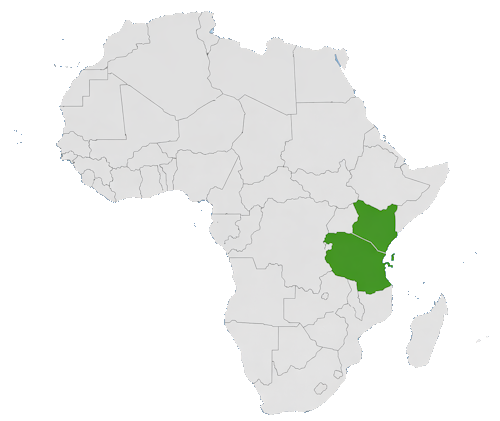
IntroSo we've been on a two week vacation in Africa, starting with Kenya, doing safaris through Tanzania and then flying to Zanzibar for some relaxation. Overall it has been great, with small hiccups, and this is the post that resulted, so enjoy!
The region
Kenya and Tanzania share the same language and approximately the same culture. People from both have said that the people want a joining which is hindered by politics. Tanzania itself is a republic created by the unification of Tanganyika and Zanzibar. However, from my perspective, there are big differences between the three regions, even if the borders between them are pretty much random lines drawn by the British or other colonizers.
A tip driven culture, they expect tips for everything after volunteering to do things no one asked them to do, like carrying bags or doing random welcoming gestures of apparent kindness. We never knew how much to tip and who, so the reactions we got cycled between annoyance and reverent gracefulness, sometimes from the same people.
Tanzania has more food and less economic inequality, but a slower economy and a cheaper standard of living compared to Kenya. However, I've not seen the squalor and apparent lack of self esteem that I saw in Kenya. Tanzanian people are proud of their first president, who attempted to build the nation and keep it safe. An educated man, he came with a political ideology known as Ujamaa, a form of African socialism. For that reason, their houses are neat, no matter how cheap and they believe in the future of their nation. Conversely, in Kenya the poor are really poor and the rich are way richer, their houses are just hobbled together and the people sleeping on the side of the road are a lot more there than in Tanzania.
I won't get into the history or politics or whatever, though. The important part is that people are mostly similar and they speak Swahili in all three of these regions, written with Latin letters. Many African tribes live peacefully within these borders, with the largest being the Maasai.
Also, the climate is not that different from parts of Europe. We went there in January, so summer in the Southern hemisphere, but the temperature rarely went over 30 on the most heated days. Meanwhile, nights were often chilly. They never get negative temperatures at ground level and considering I was coming from a city where nights had -15C at that time and that can easily get to 40C during the summer, I felt it was quite comfortable.
For me, there were two separate legs of the journey, one was the Masai Mara/Serengeti safaris and the other was the Zanzibar island. In one we woke up before the sun rose to get something to eat and then be driven until evening in the natural reserve to see the landscape and animals and the other was pure lazing around and swim in the pool. Yet by far the most satisfying was the safari.
Getting there
In order to get from my home country of Romania to Kenya, we had to take two flights, one to Doha and another to Nairobi. Both were Qatar Airways which I have to say has not disappointed as an airline. Planes were comfortable even for my long legs and the flight attendants very professional. But it was about 500 Euros per person and it took a lot of time.
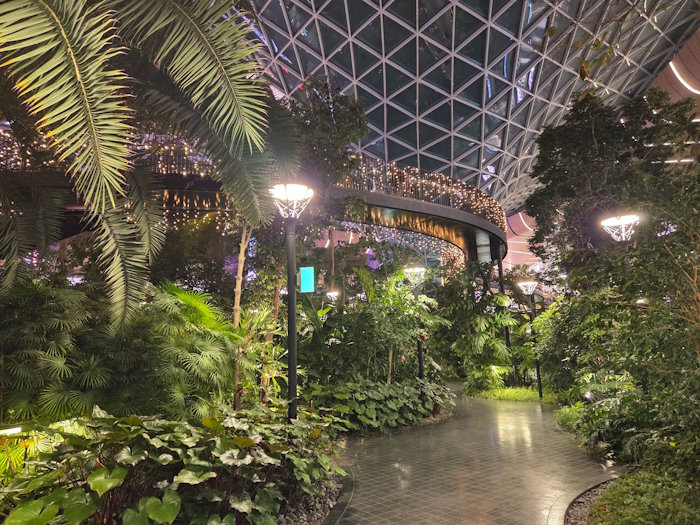 The Hamas International Airport is a huge place, including all kinds of shops, restaurants and even an Orchard with trees and flowers and places to lay down and sleep in the (artificial) sound of birds singing.
Once we got to Nairobi we found the first obstacle: language. I consider myself a pretty good English speaker, but apparently I am not very good at hearing it. Because when we went through customs there was a scary Black man there telling me "put right hand fofinga the'e", pointing towards a sensor. I've put my forefinger on the sensor and the guy got angry. "Fo fo fo!". I thought that "fo" must be "no" in Swahili and placed my forefinger on the sensor again. Guy got agitated and started Nazi-saluting in a frenzy shouting "Fo fo fo fo!". Jesus, what was I doing wrong? My wife comes from behind and says "Honey, he means four fingers".
And it wasn't the only time it happened. Later on we went to a restaurant and the waiter started to make conversation. I told him I am Romanian and this is how the dialogue continued:
- "Oh, I have a friend from Romahnia. He's pasta"
- "He's passed? I am so sorry!"
- "Ah, no, he's peachy! Cha-cha pasta"
- [me confused] "Oooh-kay. Glad he is well"
My wife comes and says "Honey, he means a church pastor, he is preaching".
I mean, even our safari driver/guide, when I asked him what a secretary bird eats, he told me "Snacks". Well, doesn't everybody?! He meant "snakes". OK, that's the end of the comedic monologue. I won't inflict much more of my dad humor on you further on, so keep reading.
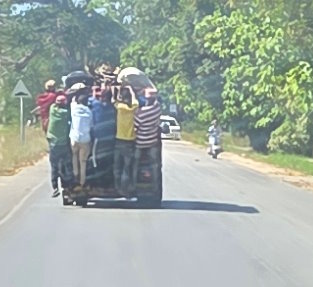 From the airport we got picked up by our first driver/guide who got us to the Masai Mara park, where we were to go on safari. Driving in Kenya and Tanzania is insane! Most cars are Toyota or something similar, a lot of cheap Chinese motorcycles and big trucks that I didn't recognize the brand for, but they are all really old. The average citizen cannot afford a second hand car, and most can't even dream of a new one. If you see a new car on their roads it is usually a government official or some company car. Trucks spew smoke like they're on fire, especially if they have to go on a hill, and old cars also look like hazards, especially with the way people are driving there. Occasionally you may see a "bus" that has a lot of people inside and some hanging over the back of it, only part of their arms being "inside" the bus.
In Europe (and I expect in other developed places) driving is constrained by clear rules which are enforced by authorities. That gives one some consistency of expectations and the luxury of badmouthing or even honking at other drivers. Not there! Almost no one honks (and I expect no one bothers to complain on someone else's style) because there are absolutely no rules. Except, maybe, to never ever stop. What in Romania would be considered a two lane road with each one in a different sense, for them it's more like five virtual lanes. They drive the British way, on the left side of the road, with the steering wheel on the right. If a car is in front of them and moving too slow, they just overtake with little consideration. Meanwhile, someone might feel like you are not overtaking fast enough, so they overtake you while you are overtaking. And in all that time, there are small motorcycles that can come from either direction on any side of the road.
But guess what? I don't think they have that much more road accidents. People don't have the sheltered expectations that the other drivers will follow any rules and have the freedom to drive as they want as well. Their actions have very real and direct consequences that depend entirely on them assuming the responsibility of taking those actions. It feels free and adult. Until the first crash, obviously, but I am just telling you my impression. After fearing for our lives for an hour or so, we kind of got used to it.
It probably helped that our driver was very careful and considerate with the car - which was obviously not his - and with us, even while driving like this.
Oh, and they absolutely love speed bumps, even on the compacted dirt roads, which are probably most of them. Every school has a few of them in front. And there are a lot of schools in Kenya, run by various Christian organizations. Imagine the people that hang on to the outside of a bus, completely trusting the driver will not speed over any of them, throwing them off.
Anyway, the drive to Masai Mara and similar other drives in Tanzania were the only way we would see how most people lived. Houses are small, made of dry soil and wood branches, some times coruscated tin sheets, other times whatever people found to make their houses of. There is no pattern, no homogeneity and there is garbage everywhere. On the side of the road you see all kinds of small business, but also people laying down or sleeping on the grass. When I asked about them, the driver just said "they are waiting for a job".
The weird English they retained from their colonizers is also funny. A farmacist is a chemist, an Internet place is a cyber and apparently the name Ebenezer is very common. I was imagining a small Kenyan old grandma appearing next to me saying "Welcome to Mama Ebenezer's Cyba Chemist!" "The what?!" "Yees, we have free rooms!". I've seen a lot of "hotels" where were just random one story buildings with signs on them, with "star" being a popular motif in their naming. "The star hotel", for example. I thought it would be funny to name it the five star hotel and just a few hours later I've seen a "Five star hotel" which was just like any other star hotels I've seen that far.
A lot of people still live in the old ways, by raising goats, sheep, chicken and sometimes cows, and you can see those just eating around the garbage strewn on the sides of the road. That's the bonus road lane, I guess.
Masai Mara/Serengeti
The first things you notice when you get to the reservation are animals. You see some even before you get there, but inside the reservation there are trees and birds and open spaces that are completely protected from man.
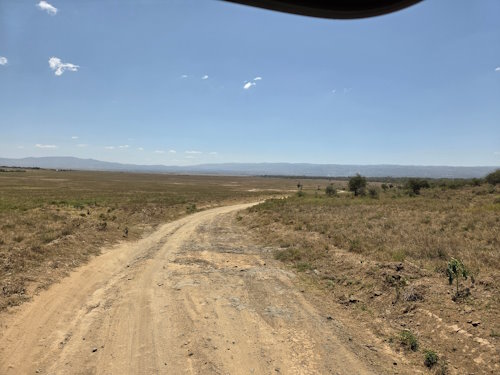
It's worth saying that hunting or domesticating any wild animal, regarding on where it is found, is illegal in Kenya and Tanzania. You cannot just shoot an antelope and eat it or raise zebras in your back yard. There are exceptions where specific tribes have this as part of their tradition. And I do believe those exceptions are not part of the law, just people turn a blind eye to this kind of thing.
A notable exception is the Guinea fowl, colorful funny birds that are related to chickens and which I was told are allowed to be raised just like normal yard birds.
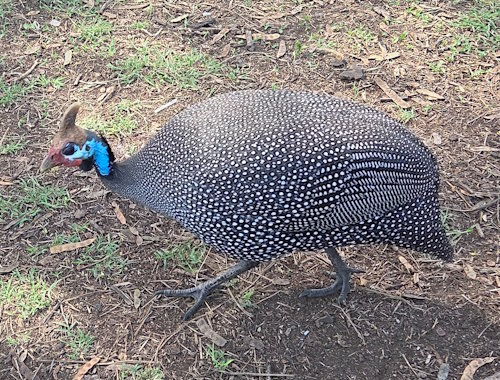
Back to the Masai Mara/Serengeti area, I have to say that to have such a huge place protected from human development and hunting is a great achievement! I know that it's probably something that was convenient at the moment and it will survive until some Trump hears it holds valuable resources underground, but as long as it lasts, it's so very nice. I wish we had stuff like that in Europe. Perhaps only in Russia can we get something similar and with the politics of the place, I doubt we'll get there. Also, while the areas you can go on a safari in are huge, they are just a very small portion of the Serengeti ecosystem.
The Masai Mara name comes from the name of the Maasai tribe and from the word for "spotted" in their language. It thus translates to "the spotted land of the Maasai", called so because of the vast flat plains speckled with the occasional tree, termite mound or shrub.
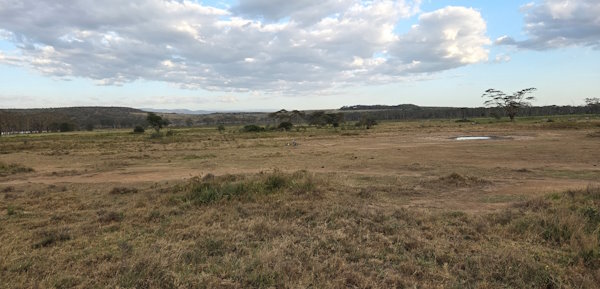
With the careful guidance of our driver, we saw a lot of animals. The plant life is pretty unimpressive, though. There are some cool trees, but few types and far between, while the small plants are mostly grass and shrubs, with just a few flowering plants.
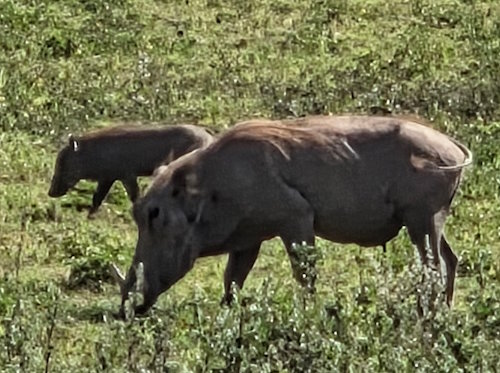
My favorite animal was, of course, the lord of the savanna, the uncontested champion of smarts, beauty and grace: the warthog. Just like me, he avoided people and was constantly searching for Wi-Fi. Even if the Swahili name for it is ngiri, most people there called it pumba, which means silly, foolish or simple. Apparently, they are very forgetful (just like I am) and even if they spot a predator and run, five minutes later they forget and go back to the same place the predator never left and just got better hiding.
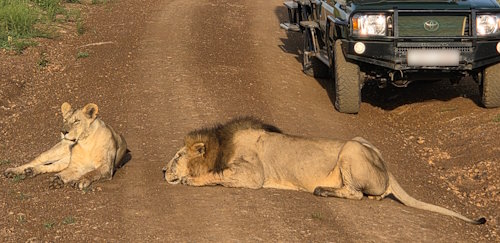
The big cats were beautiful: the lion, the leopard, the cheetah. Our guide told us that lions are considered kings not because they are smartest, most beautiful or more powerful, but because of their attitude, fearless and confident, like everything just naturally belongs to them. I felt like they really put the lion in "lying around".
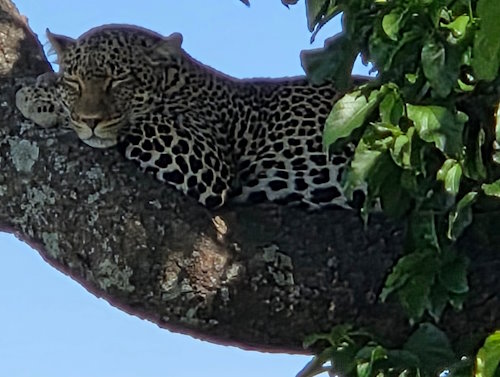
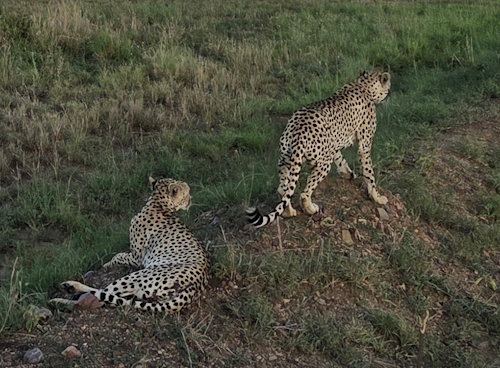
We've also seen another cat that looked like a serval, but it wasn't according to our guide. He told us the name, but I forgot it. Really beautiful fur patterns, but the photo is not that good.
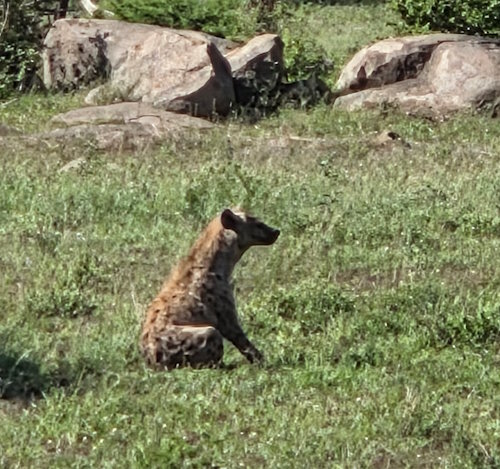
Hyenas are very smart. They hunt in packs, but then they tear their capture apart and eat separately. They are also considered very cruel, since they don't use suffocation to kill their prey, instead eating it alive until it dies of blood loss. I also considered them cute, but then you know I have a weird sense of aesthetics.
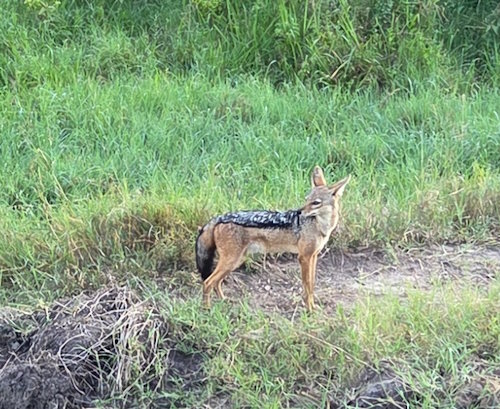
The only canine we've had the privilege to spot was the black-backed jackal, a fox sized and looking animal that always kept watch for something bigger trying to eat it.
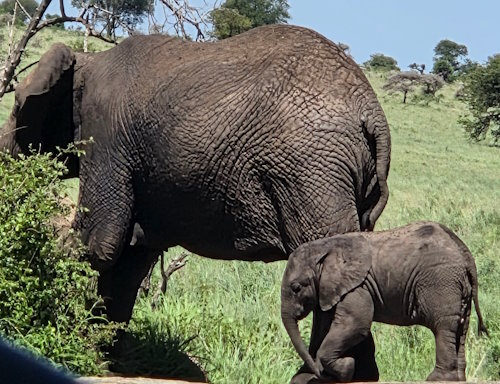
Then there are the elephants, of course, which I've seen a lot of. They live up to 70 years old and move slowly and carefully, grabbing grass with their trunks and eating it. They have wise yellow eyes and every time we came near them, they were never afraid, but always moved just the right way in order to put themselves between us and their small ones.
We've seen rhinos as well, but only from afar. There are only black rhinos in the reserve. The white/black name stuck, but it's a mistake, since the defining difference between them is the snout and mouth, not the skin. The "black rhino" name comes from "the black-mouthed rhino". Because they are very solitary animals, their numbers are dwindling and you rarely can see one.
Hippos are there as well. They are considered extremely dangerous, since they are very territorial and very violent when attacking. They sit in the water all day long and go out to graze in the night. They are so efficient at eating grass that they leave these meandering narrow paths behind them where there is only dirt and absolutely no plant.
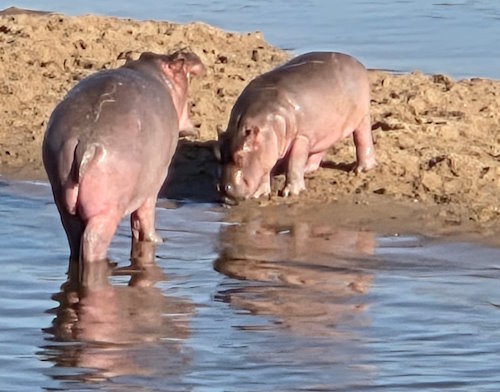
I don't know how dangerous they were, but for sure there were stinky as hell. They sit in the same stagnant water where they defecate continuously. People say that the defecation is to tell other hippos where their territory is and keep them away. I say they keep everything away with that awful stink.
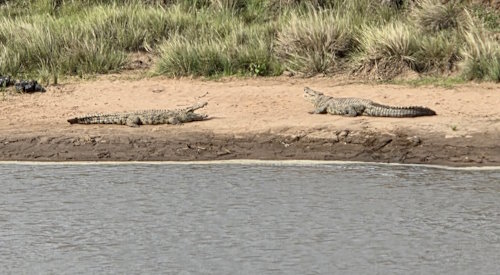
And from far away we've also seen crocodiles. In the water you see maybe a small shadow under the surface, but on the ground they bask in the sun in all of their three meter length glory. I have the photograph of these two chatting very very very slowly with each other.
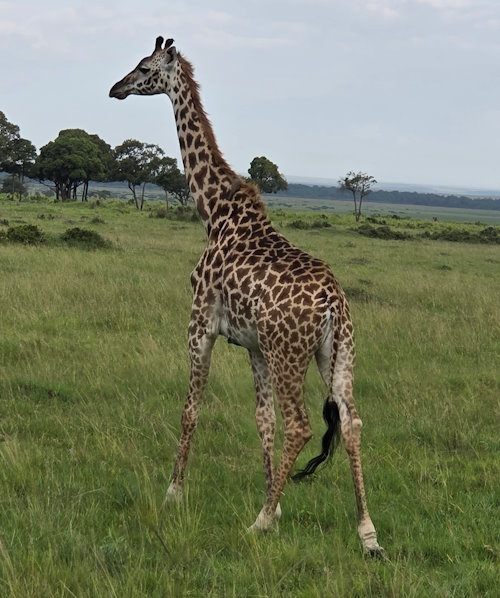
Then there are the giraffes, three species of them, but only two in the area: the Masai giraffe and the Rothschild's giraffe, and we've seen them both. Really graceful animals, until they get scared and start running, which felt like they were going to fall and break apart at any moment. It never happened, though.
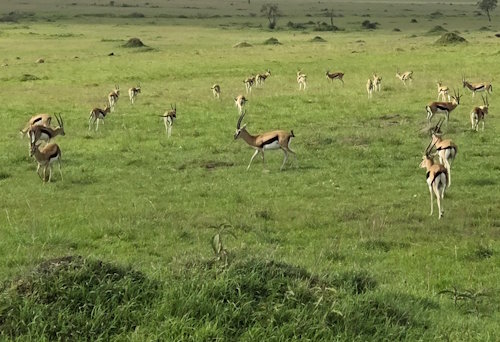
Zebras are everywhere, as are African buffaloes. A lot of types of grazing antelopes/deer species as well. It would take too long to list them all. I liked the Dik-dik, which is really small and cute. You can imagine my confusion when the guide told us the name the first time and I heard it wrong.
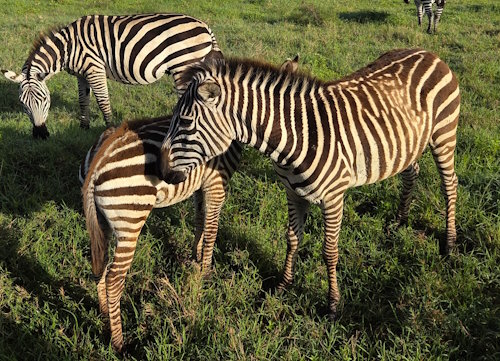
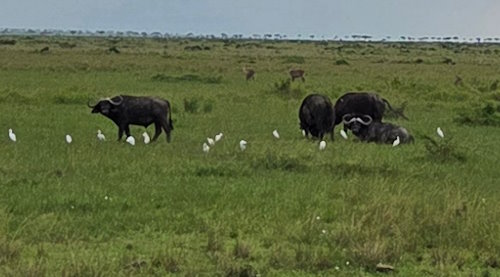
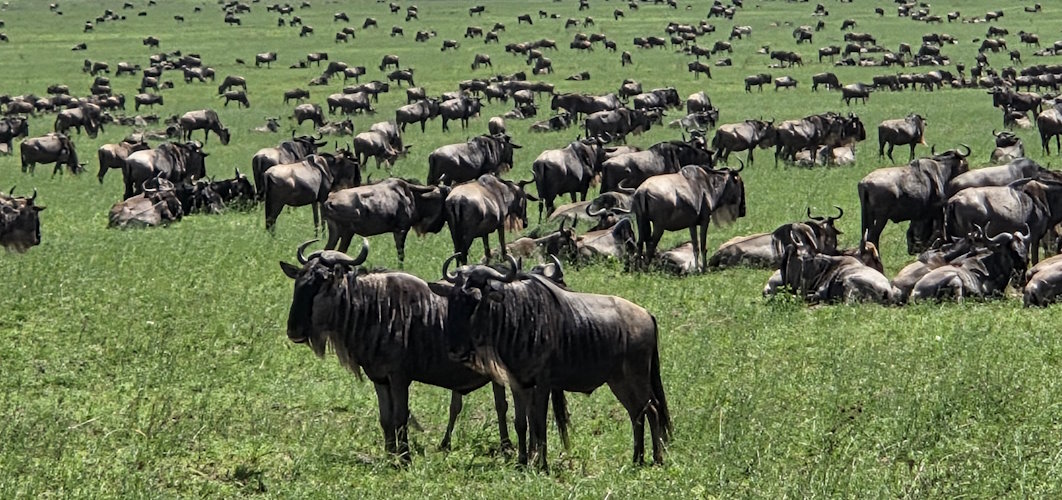
We passed through a migrating group of hundred of thousands of wildebeest and zebras going through the Great Migration to the south. It was amazing to see. A lot of flies, though. When the migration is in full swing, there are millions of these animals in the same place. Buffaloes have good smell and zebras have good eyes, so they migrate together to detect predators better. You often see two zebras one next to each other, but oriented in different directions, resting their heads on the ass of the other. This way they rest and watch both directions for danger.
We saw baboons as well, they are somewhat silly and cute at the same time, until they yawn and they show long sharp canines. Apparently they are "cheeky bastards" and if you let them, they will come into your house and cause havoc. I've always seen them in relatively large families. Not aggressive by default, they can become dangerous if they feel threatened.
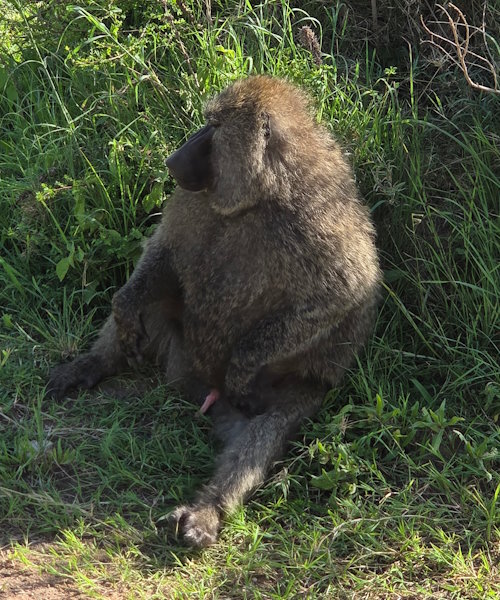
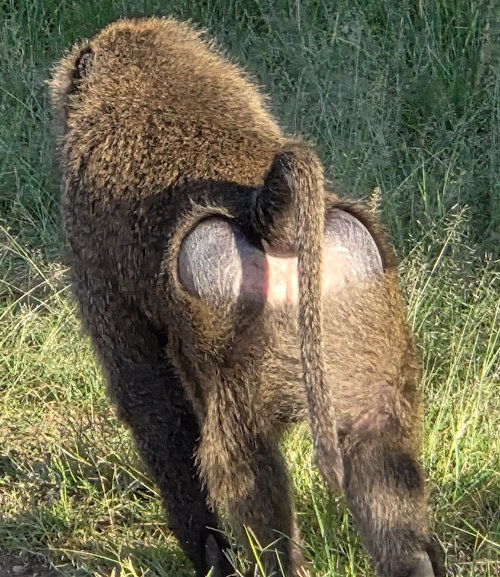
At one time I was trying to take a photo of some tribe of baboons hanging on an antenna when I noticed one that was sitting right next to me, a big male. I was on foot, since we were in a gas shop in the Serengeti. Didn't have the guts to look him in the eyes and take a photo, so I only got his butt.
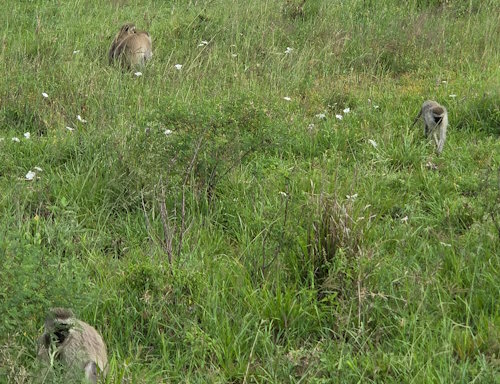
Similarly, there were vervet monkeys, nicer fur but smaller in size. Usually in smaller groups or even just couples, they are beautiful, but apprehensive.
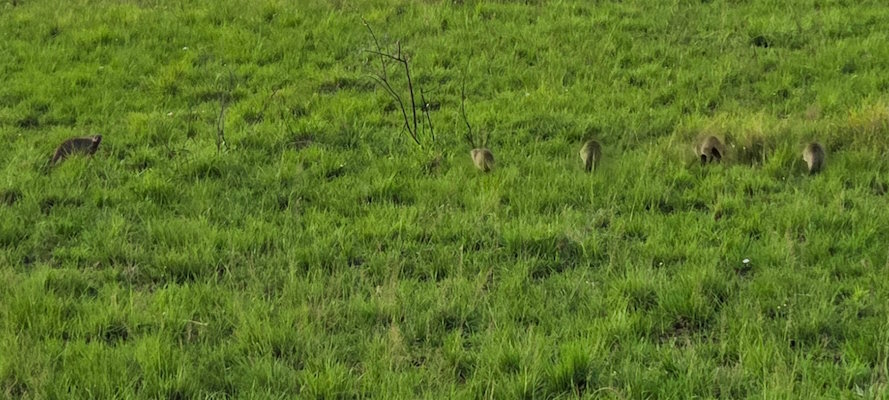
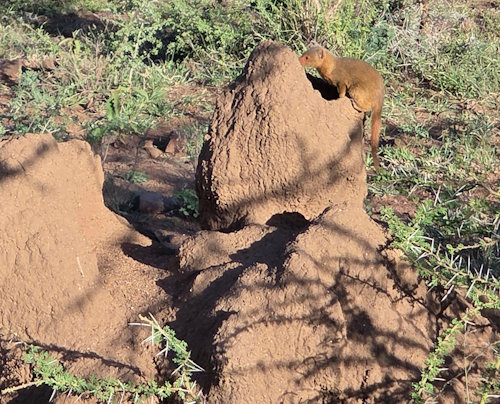
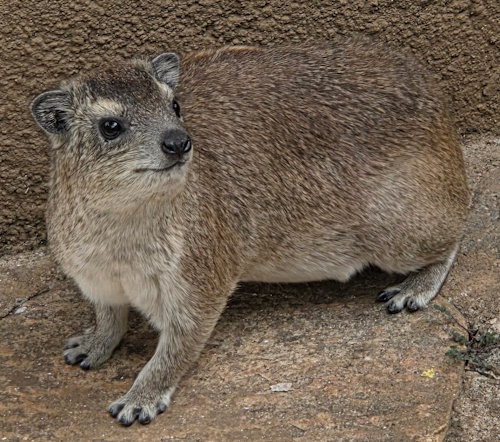
And last, but not least, the mongooses and the hyrax. Quite different animals, but we saw them at the same time. Banded mongooses are striped and always in large groups, the dwarf mongoose (or maybe some other) we've only seen when coming out of their burrow in an abandoned termite mound. The hyrax is a rodent-looking creature, but more related to elephants instead.
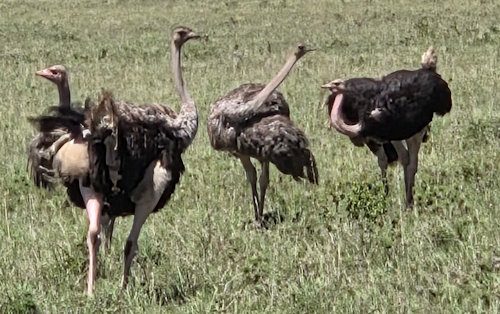
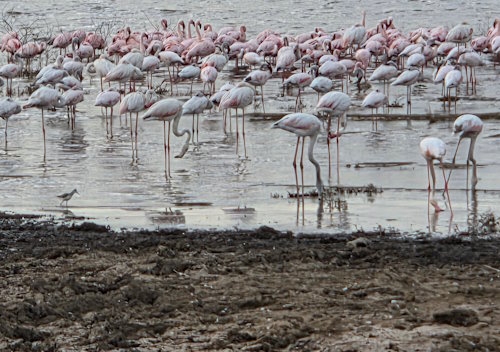
Also, birds. Since they were usually small and far away, I didn't catalog them, but they were many and beautiful, ranging from half finger length to huge eagles and vultures. We saw flamingoes. Ostriches, too.
More getting there
The safari car - a specially made Toyota Safari Land Cruiser - drove us from airport to Masai Mara, the lodge there, then on safari, then to the Tanzanian border. Another driver got us from there, because different drivers are licensed for different countries. The Masai Mara and Serengeti areas are basically the same thing, only the first is in Kenya while the other is in Tanzania.
At the border the officer there took a glance at our document and threw them back dismissively "no Visa!". We panicked a little, we learned we had to pay 50 USD on a Visa, filled out the form, only to the guy to take a second look and say "Ah, you're from Romania, no Visa needed".
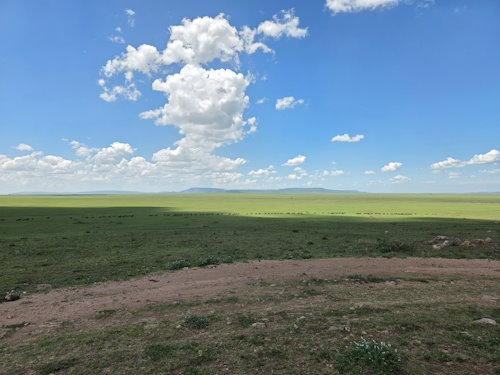
Then we drove to the Serengeti, even faster and more insanely dangerous than before. The Serengeti name means "endless sea" because it's like a sea of grass. It's impressive to stop in places where any direction you look you only see grass (and occasional trees) to the horizon, then a blue sky with fluffy white clouds. It looks just like the Windows default desktop background, only better.
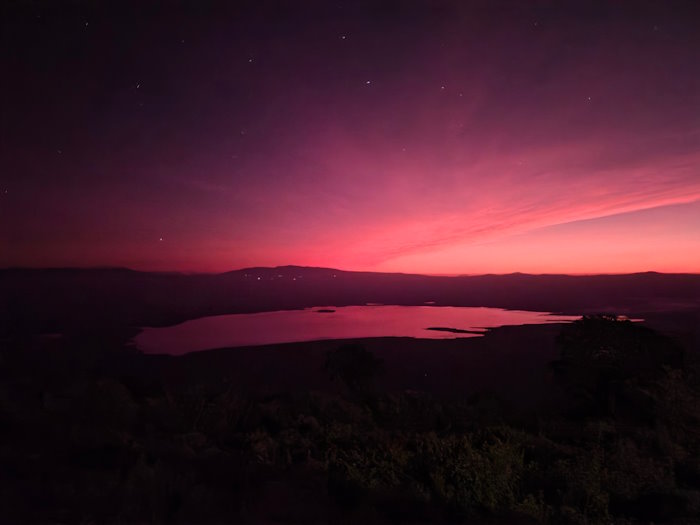
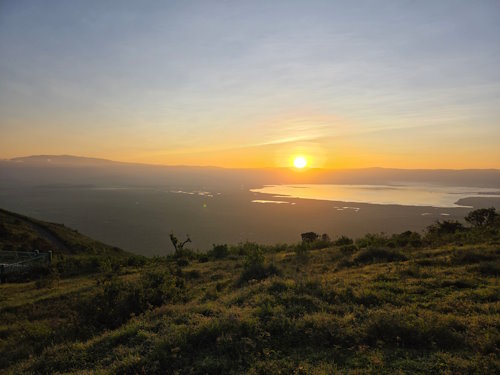
Again we were hosted in a lodge, spent the next days on full day safaris, went to Ngorongoro, which is an old volcanic crater where animals are a lot more calm and the weather more wet. The surface of the crater is 380 squared kilometers.
Finally we got to the Kilimanjaro International Airport in Arusha from where we were supposed to get a one hour flight to Zanzibar with Air Tanzania. Man, what a shit show!
First of all, the plane schedule had been changed just before we left Romania. We knew that and that it means we had to leave five hours later, but we had nowhere to wait except in the airport. When we got there, we had to remove all things from the pockets and our shoes (which were worn non stop through six days of safari) and put them on the scanner belt *before* we entered the airport. We would have to do the same when boarding the plane, too.
But when we got there, we realized we cannot check in. I had previously tried to check-in online, but the portal asked for a code I didn't have and it seemed like it was designed to be used by airport personnel rather than passengers. At the airport, the check-in process only started two hours before the plane was scheduled. Yet, at the same time, the restaurant and any snack or drink dispenser were after the security gate.
The solution? African way, of course, I had to bribe an airport officer to order us the food and bring it through the check in point. There was also a toilet there, but whenever we were getting close a "welcoming attendant" was shouting "Jambo jambo!" at you (which means hello) and inviting you in. It felt more like "welcome to my parlour, said the spider to the fly" than "go on and tip me" which is probably what he meant. Anyway, we chose to hold it in.
Another fun thing, the flight did not appear on the departures list on the airport monitor. After asking around some really uninformed people, I got to learn I could just ask in the Air Tanzania office which was outside the airport. Could I just exit and come back on? The security guard said that it was perfectly OK. So I went there, where three people were lazing around doing absolutely nothing, and asked them. They answered the plane was on time, that their colleagues in the airport missed updating the monitor and that they were going to tell them to do that immediately. Oh, good!
And of course I had to get out of my shoes, belt and empty my pockets when I got back in the airport, 3 minutes later. And of course that until the check-in opened, three hours later, the departures monitor was not updated with our Air Tanzania flight. It was updated with a similar Air Tanzania flight, though, which was leaving another six hours later, which of course, filled us with confidence. But I am not bitter, I take the higher road, hakuna matata and all that. Motherfuckers!
At the Zanzibar airport, at midnight, our transfer car did not arrive. Chat on the website designed to reach the driver did nothing, calls - from some guy outside the airport because I had no roaming in Zanzibar - to the dispatcher of the company went unanswered. In the end we just took a taxi from a helpful guy. The rideshare driver apologized the next day and promised to come and bring us the money we gave the taxi. But then asked for the voucher code, which we refused to give him until we got the money. Never heard from the guy again.
So the whole "getting to Zanzibar" thing was fun. Not bitter, though.
Zanzibar
Our hotel had small funny huts, a pool with a swim to bar, was next to the ocean, relatively good food - the safari lodges were better - so we got a well deserved relaxing rest.
I was there with the wife, so of course I had to drink less and visit stuff more. But I am not bitter. I take the higher road. It was the right thing to do.
We went to the sea immediately. Such fine white sand, almost like clay, and the tides were phenomenal, the way the waves were coming right close to the hotel and a few hours later you could walk were the water was deep before. But we could not enjoy it much because the beach was infested with jambo-jambos trying to make conversation and sell you things.
Then there were two things we wanted to visit: a Zanzibar spice plantation and Stone Town, where there was also the Freddy Mercury house. I am a big fan of Queen, so it had to be done. So we spoke with a tour agent right there in the hotel who offered us a drive to a spice plantation, a guide there, then a ride back for 75 USD. And my wife refused, but we talked to a guy there who recommended us another driver. I told him that we were offered 75 USD and he immediately called a guy and negotiated a driver, a guide, the spice plantation, Stone Town, all in 80 USD. I guess I could have said 50 USD and he would have sold me the same for 55 or something, but I didn't really mind the price.
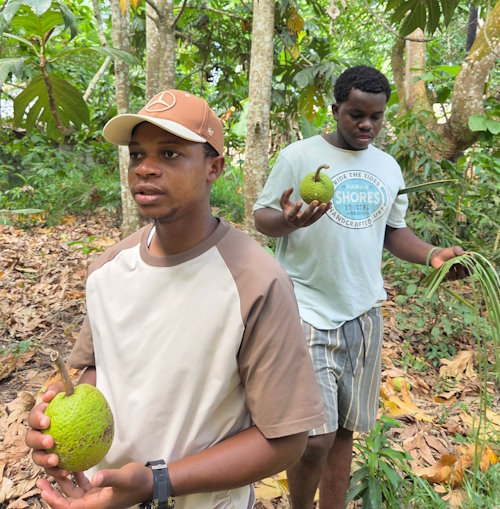
The plantation was fun, it was more of a small orchard than a sprawling plantation as we imagined. We saw how they grow pepper, cardamom, ginger, turmeric, dragon fruit, jackfruit, durian, bread fruit, lychee, bananas, some stuff African women use as lipstick and Maasai put on their forehead like the Indians, mandarins, vanilla, cloves, cinnamon, aloe vera, chilly peppers, Zanzibar apples - which are not apples, coconuts and so on.
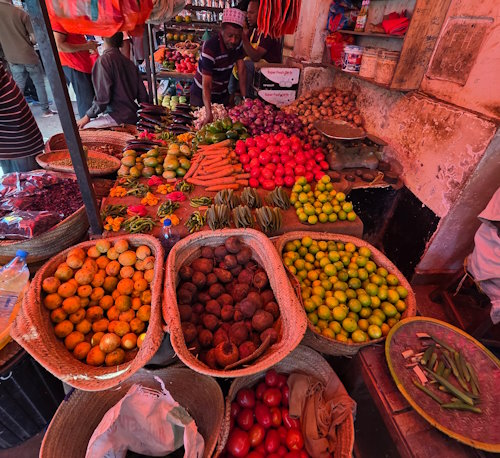
Stone City was a really hot narrow street place like you see in many a tourist place. Took some pictures, including the outside of the Mercury House. Apparently, since he was Indian-Iranian and he only stayed in Zanzibar when he was a child, people there don't feel Freddy was one of theirs and the "house" is just a place with some pictures, so we didn't get in. We went to a market there, which was pretty claustrophobic. A drunken guy came to us and started repeating he is "Aaaffffrican Aaarrtist". So just like home.
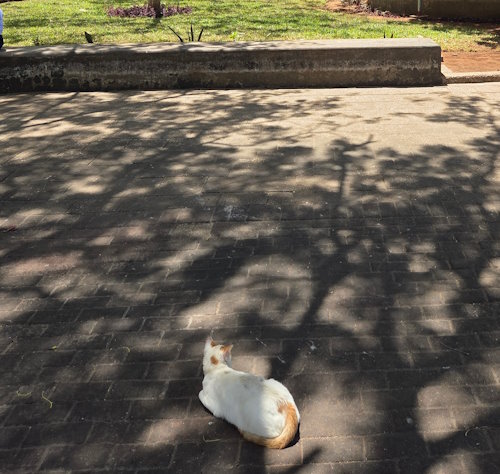
But there were a lot of cats! In Romania there are a lot of stray cats and people have a lot of dogs. Outside of Bucharest you see a lot of stray dogs, too. Not in Kenya and Tanzania until we got to Stone Town. They were laying around, sedated by the sun, you could just go to them and pet them and they wouldn't even move.
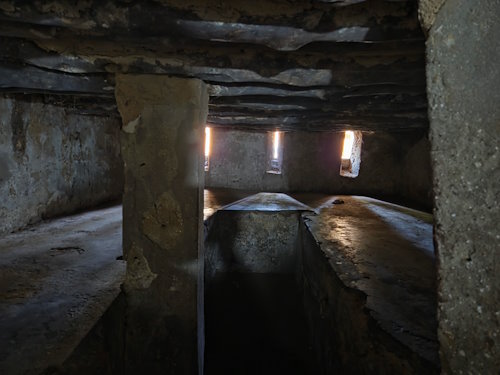
Also, we went to the *former* slave market, emphasis theirs, as if we wanted to get there to buy a little African child or a slave for home. Not much to see except a dark damp cellar where stone slabs held the role of beds and the space between them as toilet. The small holes in the walls served as "windows" and toilet flushers when the rains came and flooded the room.
There was a sculpture there that moved me. Four black silhouettes, same chain on their necks, and a fifth, also black, but unchained. The supervisor, also a slave, but "middle management".
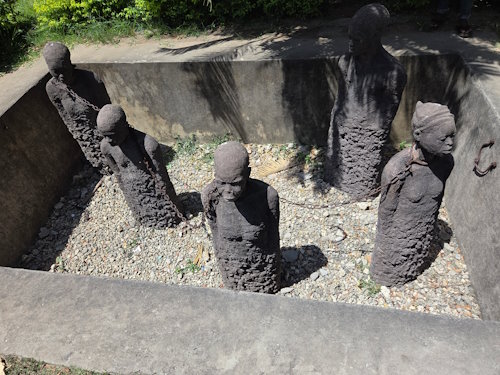
I was reminded of so many movies decrying slavery that present some angry aggressive rapist as the master, when it would me much more impactful - and probably closer to the truth - to present them as some calm speaking polite gentleman who has only kind words to speak to slaves, except for when they misbehave, so they sorrowfully instruct the supervisor to administer punishment. And if the supervisor misbehaves, just as politely and following "the rules" they demote the supervisor to a mere slave and promote another, perhaps the one that was viciously punished the day before.
Not different from a modern corporation, I guess. But I am not bitter. I take the high road. At least until I find a job... As I was saying to one of the people I talked to there, rich people don't hurt poor people, they hire other poor people to do it.
We also went for snorkeling! I came back to the boat three minutes later. I heard it was a lot of fun for all the other people. Nuff said.
The food
We never went to eat with the locals, as we were always pampered in a lodge or hotel that was made for tourists. The food was also for tourists. I understand that the regional recipe to enjoy is Nyama Choma - basically grilled meat. They eat it from the bone, taken together with ugali - a white corn polenta specific to the region - and with kachumbari - tomato onion chilly salad - or a blanched spinach like plant (sukuma wiki). It was pretty good at the hotel restaurant, but I ate it with a fork, not with the hand as traditional.
Are the fruits amazing and so different from what you get from the supermarket at home? Sometimes. But mostly no. It's not like you can eat papaya daily or find nice pineapples in Romania, so in that sense it's great, but at least from the restaurant food we've had, fruits are fruits. Perhaps if you take them from the local markets, things are different, but how much can they be, really?
Health and hygiene
I purposefully left this at the end, because I know you would want to know, but since it's health advice, I can't really give it.
What I can tell you is that before going to Africa from Europe, you are being told all kinds of horror stories: malaria, diphtheria, typhoid, yellow fever, hepatitis, sleeping sickness, mosquitoes, tsetse flies, etc. And while some of this might be true, it's increasingly rare in Kenya and Tanzania.
It also depends on whether you are hosted in a "hotel" on the road to Nairobi or a safari lodge. Mosquitoes are there, but in order to infect you with something serious, they have to first sting an infected person then sting you. If you are in a luxury hotel made for foreign tourists that is rather unlikely.
However, we did get vaccinated against the yellow fever - it's mandatory in order to get into Tanzania - and sprayed ourselves with Deet whenever we thought it was required. We also bought - from outside the country - Malarone to preventively treat a possible malaria infection, pills that you have to take daily.
To my very pleasant surprize, there were not many insects in the places we've been to, including the safaris. I was expecting the same thing you get in European plains and forests: a lot of flies and mosquitoes. It was mostly free of them, at least in this period, which marks the end of the dry season. Perhaps during the wet times there are more insects.
On the other hand, in the lodge in Ngorongoro the first thing I asked the reception is what the mosquito situation was and they confidently told me the edge of the caldera is too high for mosquitoes. One minute later I was killing two of them in the bathroom. Mosquitoes, not receptionists.
As for the water, we were given bottled water to drink and to wash our teeth with, but I feel it was mostly to alleviate concerns than from a practical perspective. Maybe in the lodges it was warranted, but in the Zanzibar hotel where you had 3 showers a days and spent most of the time in the pool I doubt the water quality was any worse than at home. Of course, again, it depends where you are.
Conclusion
I recommend everyone to go on an African safari at least once. The animals, the wide plains, the experience of just sitting there (in the car) two meters from sleeping lions. Really great!
And take the lodges, not the camps, even if more expensive. It's worth it for your peace of mind at least.
The Zanzibar hotel experience you can safely skip. I would have probably regretted it if I didn't do it, but now, if I were to return, I would only do the safari, maybe just in the Masai Mara or in the Serengeti, not both, and come back.
Also, considering plane tickets are 2000 EUR for two people at least, it's worth spending enough time there to offset that cost with experience and enjoyment.
While I usually advocate going to a place and living with the locals to really understand it, I can't recommend this for Kenya and Tanzania. They have at least a few decades until they reach a reasonable development level that most Westerners or even East Europeans would consider safe, and that considering they don't have yet a stable region, an African Union or anyone to protect them from themselves and from predators while they grow.
In fact, the opposite is true, with instability and dependence actively being promoted by all major powers West or East. Most Africans dream of becoming protected by and integrated more with Europe. That won't shield them from explotation, but it's their best choice in this insane world.
I felt awkward when meeting with the local population, especially with the tribal people. They made me feel like a colonizer: poor, begging for a bottle of water or a piece of chocolate or a tip, some pushed by law from their lands into others. They are not in reservations, like Native Americans, but they are not free to move anywhere either, having no education that would allow them to blend in with what we call "civilization". Even the people that we interacted with: educated in hospitality schools, speaking English, they had no idea what's outside. They never left their country, rarely watched any movie or series or outside news. They speak the words, but don't understand the memes. In a way, this is good, staying away from the corrupting influence of other cultures, but at the same time it's pointless. I reminded a guy from Zanzibar who was saying that their cultural identity is important, that the same identity was created by a guy who was educated in the UK, went to university in Edinburgh.
Overall a worthwhile experience that I am glad I had.
Comments
Be the first to post a comment